The Great Uncoupling: What the UAE’s OPEC Exit Means for Your Energy Future

The global oil landscape shifted on May 1, 2026, as the United Arab Emirates officially ended its 59-year membership in OPEC. This “shock” move, coming in the middle of a major regional energy crisis, effectively transforms the UAE into an oil “free agent”.

Why the UAE Walked Away

The decision follows years of internal tension between Abu Dhabi and the Saudi-led cartel over production limits.

  • Production Handcuffs: The UAE has spent $150 billion to expand its oil capacity to nearly 5 million barrels per day (bpd). Under OPEC, it was restricted to roughly 3.5 million bpd, leaving billions in potential revenue on the table.
  • National Interest First: UAE Energy Minister Suhail al-Mazrouei clarified this was a strategic policy shift to maximize domestic wealth and fund the nation’s transition into non-oil sectors like AI and green energy.
  • Regional Discord: Tensions with Saudi Arabia over regional leadership and the ongoing conflict in the Gulf made the strictures of the alliance increasingly untenable for Emirati leadership.

Impact on Global Supplies

While the UAE is now free to pump at will, the physical supply of oil hasn’t changed overnight.

  • The Hormuz Bottleneck: The ongoing blockade of the Strait of Hormuz means that much of the UAE’s oil remains physically stranded. Until maritime traffic fully resumes, the country cannot yet flood the market with its extra capacity.
  • Future Surge: Experts at BBC News suggest that once logistical hurdles clear, the UAE could increase global production by one million barrels per day almost immediately.

What This Means for Oil Prices

The departure of OPEC’s third-largest producer has created two distinct market phases:

  1. Short-Term Volatility: Markets initially dipped on “supply-glut” fears before rebounding to over $112 Brent and $105 WTI due to the high “war premium” currently priced into every barrel.
  2. Long-Term Bearish Outlook: Analysts at CNN Business and Yahoo Finance note that by stripping OPEC of its primary source of spare capacity, the cartel’s ability to “floor” prices is permanently weakened. This could lead to significantly lower prices once regional stability returns.

The Market in General: Winners and Losers

The exit is a blow to the cartel’s cohesion but a potential boon for Western markets.

  • U.S. Relations: Experts believe the U.S. government welcomes the move as it curbs the cartel’s overall pricing power.
  • Stock Market Shift: According to MarketWatch, the move creates clear winners in U.S. energy stocks, while industries like airlines and logistics may face continued margin pressure until regional shipping stabilizes.

Market analysis provided by The Macro Compass is for informational purposes only. Please consult with a financial advisor before making investment decisions.
Operation “Project Freedom”: Naval Escorts in the Strait of Hormuz

The global energy market is currently at a high-stakes crossroads. On May 4, 2026, the U.S. will officially launch Project Freedom, a major initiative to provide military escorts for commercial vessels through the Strait of Hormuz. This move, announced by President Donald Trump, aims to break a weeks-long maritime gridlock that has paralyzed one of the world’s most critical energy chokepoints.

The Current Crisis in the Strait

The Strait of Hormuz, a narrow waterway south of Iran, typically handles roughly 20% of the world’s oil and liquefied natural gas (LNG). Since the outbreak of conflict in February 2026, passage has become a high-risk gamble:

  • Widespread Blockades: Iranian-laid sea mines and threats of drone or missile strikes have effectively closed the channel to most neutral commercial traffic.
  • Stranded Cargo: Approximately 230 oil tankers and numerous LNG carriers are currently idle in the Persian Gulf, unable to deliver their vital loads to global markets.
  • Insurance Shocks: Tanker insurance rates skyrocketed to over 10 times their normal levels, making passage economically unfeasible for most shipping lines.

How Escorts Affect Oil Prices

Markets have historically reacted sharply to news regarding the Strait, and Project Freedom is already shifting the narrative.

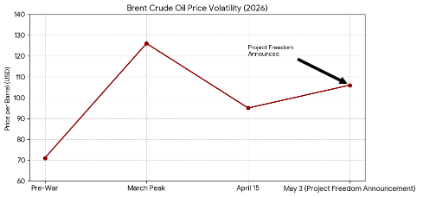
  • Stabilizing the Supply: By guiding stranded tankers out of the Gulf, the U.S. Navy aims to inject millions of barrels of crude back into the global supply chain. Initial reactions saw Brent crude dip toward $106 per barrel following the announcement, down from peaks of over $120.
  • Lowering Risk Premiums: The U.S. is also offering affordable political risk insurance through the Development Finance Corporation to encourage shipping lines to resume transits.
  • Inflationary Pressures: Despite the escorts, prices remain roughly 50% above pre-conflict levels. Experts at U.S. News & World Report note that every $10 increase in crude can raise American gas prices by 25 cents, contributing to wider inflationary concerns.

Broader Market Impacts

The ripples of the Hormuz crisis extend far beyond the fuel pump:

  • Shipping & Logistics: The backlog of ships has caused extreme spikes in overall shipping costs, affecting the price of global goods.
  • Agriculture: Disruption to fertilizer production—specifically nitrogen and phosphorus—threatens global food security, as rising costs may lead farmers to reduce usage.
  • Asian Markets: Countries like China, India, Japan, and South Korea are the most vulnerable, as they historically receive over 80% of the oil transiting the Strait.

While the U.S. Navy‘s presence provides a tactical solution, the long-term health of the market depends on whether this move leads to a broader de-escalation or a further hardening of regional conflict.


Market analysis provided by The Macro Compass is for informational purposes only. Please consult with a financial advisor before making investment decisions.

The UAE’s OPEC Exit: A High-Stakes Break for Strategic Autonomy

On April 28, 2026, the United Arab Emirates (UAE) delivered a historic blow to the global energy landscape by announcing its withdrawal from both OPEC and the wider OPEC+ alliance, effective May 1, 2026. This decision marks the end of a nearly 60-year membership and signals a fundamental shift in how one of the world’s most influential oil producers intends to manage its resources.

The move comes amid intense regional instability, including the ongoing U.S.-Israel war with Iran, which has severely restricted oil exports through the Strait of Hormuz.

Why the UAE is Leaving Now

The UAE Energy Ministry characterized the exit as a strategic “evolution” of its sector policies to enhance flexibility. Key drivers include:

  • Production Freedom: As OPEC’s third-largest producer, the UAE has long felt constrained by production quotas. By leaving, it can now move toward its goal of increasing production capacity to 5 million barrels per day (bpd) by 2027—and potentially up to 6 million bpd—without external limits.
  • National Interest Over Collective Restraint: Officials stated the need to prioritize national strategic and economic visions. This includes maximizing the value of its oil reserves before global demand potentially peaks in the coming decade.
  • Geopolitical Friction: The decision reflects a growing rift with Saudi Arabia, OPEC’s de facto leader, and frustration with fellow Arab states regarding regional security responses during the recent Middle East conflict.

The Impact on Global Markets

While the immediate reaction in oil markets has been somewhat muted due to existing supply constraints in the Strait of Hormuz, the long-term implications are profound.

  • Weakened Cartel Influence: The departure removes roughly 13–15% of OPEC’s production capacity, significantly diminishing the group’s ability to calibrate global supply and stabilize prices.
  • Potential for Lower Prices: In the long term, once export routes normalize, the UAE’s ability to pump oil “unconstrained” could put downward pressure on global crude prices.
  • Opportunities for U.S. Partners: Analysts at Yahoo Finance and The Motley Fool suggest that U.S. companies like ExxonMobil and Occidental Petroleum, which have significant joint ventures with the UAE’s national oil company (ADNOC), may benefit from increased production opportunities.

The End of an Era?

The UAE follows other recent departures, such as Qatar (2019) and Angola (2024), leading some experts to call this “the beginning of the end” for OPEC’s decades-long dominance. By prioritizing sovereign flexibility and strategic autonomy, the UAE is redrawing the global oil power lines for a more competitive—and potentially more volatile—energy future.


Market analysis provided by The Macro Compass is for informational purposes only. Geopolitical events are highly volatile; please consult with a financial advisor before making investment decisions based on conflict-related data.

Why Gold and Silver Haven’t Surged Despite the Iran Conflict

Geopolitical turmoil, such as the recent escalation in the Iran war, often drives investors toward traditional safe-haven assets like gold and silver. Yet, despite attacks on ships in the Strait of Hormuz and rising oil prices, precious metals haven’t seen the dramatic spike many expected. Understanding why requires a closer look at both market psychology and broader economic factors.


📉 The Safe-Haven Puzzle

Gold and silver typically gain when investors seek protection from:

  • Geopolitical risk
  • Currency devaluation
  • Inflation concerns

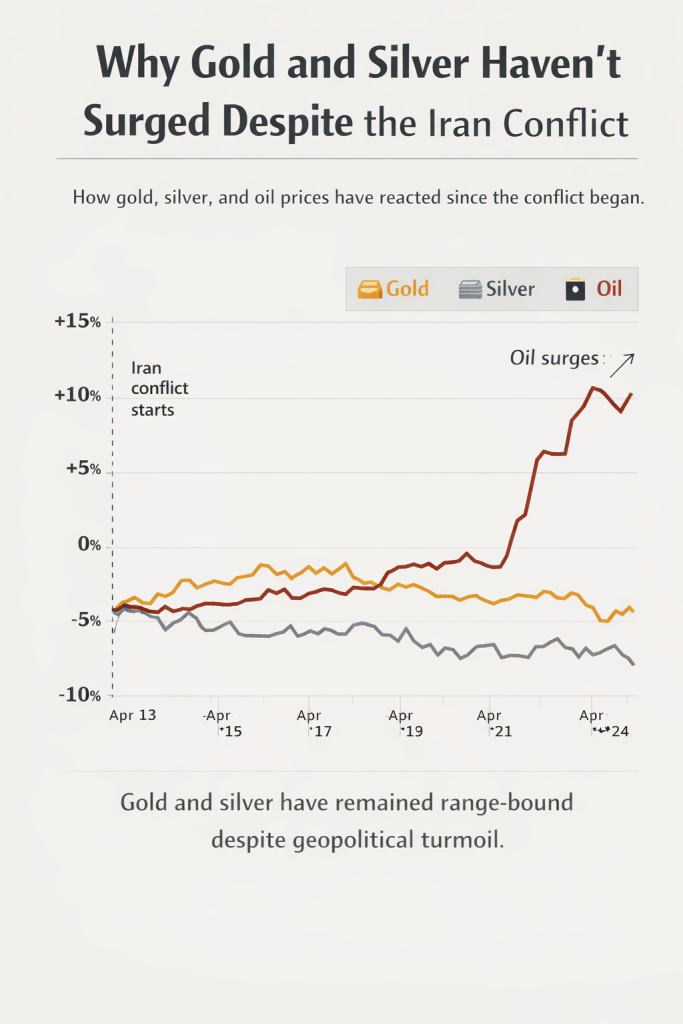
However, the current market is showing a muted reaction. Prices for gold and silver remain largely range-bound, even as energy markets and equities react to the Middle East conflict.


🔹 Key Factors Suppressing Precious Metals

  1. Strong U.S. Dollar
    Despite the war, the U.S. dollar has strengthened. A stronger dollar makes gold and silver more expensive for holders of other currencies, reducing demand.
  2. Inflation vs. Interest Rates
    Inflation is rising due to energy costs, but central banks are still maintaining relatively high interest rates. Higher rates increase the opportunity cost of holding non-yielding assets like gold and silver.
  3. Risk Appetite in Other Assets
    Some investors are rotating into energy stocks or commodities that may benefit directly from higher oil prices rather than into metals. This has diverted capital away from gold and silver.
  4. Short-Term Market Sentiment
    Precious metals often react to immediate, tangible shocks—like a sudden currency crisis or global financial panic. While the Iran conflict is serious, markets have priced in a gradual escalation, and interventions such as the IEA oil reserve release may reduce panic-driven buying.

🔹 Metals Outlook

Analysts suggest that if geopolitical tensions escalate further, or if energy-driven inflation pressures persist, gold and silver could still see a delayed surge. For now, though:

  • Prices remain range-bound
  • Safe-haven buying is tempered by strong dollar and higher rates
  • Market participants are weighing oil market profits versus traditional hedges

📊 Bottom Line

Gold and silver are not always the immediate beneficiaries of geopolitical turmoil. Current economic conditions—strong dollar, elevated interest rates, and alternative avenues for hedging—are suppressing the metals’ typical reaction to risk.

Investors looking for safe havens may need to wait for further escalation or clear signs of economic stress before metals see a meaningful rally.


Iran War: Impact on Oil Production, Prices, and the Global Supply Chain

The ongoing conflict involving Iran has quickly become one of the most significant shocks to global energy markets in recent years. Because the Middle East sits at the center of global oil production and transportation, disruptions in the region can ripple through the entire energy ecosystem—from crude production to transportation networks and global supply chains.

Impact on Oil Production

Iran is a meaningful oil producer. Under normal conditions, the country produces roughly 3.2 million barrels of oil per day, exporting about 1.4 million barrels daily to global markets.

However, the broader risk extends far beyond Iran’s own output. Military strikes, infrastructure damage, and regional instability have the potential to affect oil facilities across multiple Gulf producers and disrupt logistics throughout the region. In total, disruptions in the region could threaten up to one-fifth of global oil supply, making the conflict a major global energy event rather than a localized issue.

Oil production can also fall indirectly during conflicts because:

  • Workers evacuate or halt operations
  • Facilities are damaged or temporarily shut down
  • Export terminals become inaccessible
  • Tanker shipping becomes unsafe

Even temporary shutdowns can tighten global supply significantly.

Disruption of Shipping Routes

One of the biggest risks comes from the Strait of Hormuz, a narrow shipping channel between Iran and Oman that handles roughly 20% of the world’s oil shipments.

During periods of conflict, shipping activity in the strait often slows as tanker operators avoid the area due to security risks. When shipping routes become unstable:

  • Oil exports slow or stop
  • Tankers remain anchored offshore
  • Storage facilities fill up
  • Global energy supply chains tighten

Because so much oil passes through this chokepoint, even the threat of disruption can cause markets to react immediately.

Impact on Oil Prices

Energy markets typically see sharp volatility during geopolitical conflicts in the Middle East. Prices often rise quickly as traders price in potential supply shortages and geopolitical risk.

Several factors push prices higher during conflicts:

  • Reduced production capacity
  • Shipping disruptions
  • Increased insurance and transport costs
  • A geopolitical “risk premium” added by traders

Even if physical supply remains mostly intact, markets often bid prices higher simply due to uncertainty.

Effects on the Global Supply Chain

Higher oil prices and disrupted shipping routes can have far-reaching consequences beyond the energy sector. Oil is a fundamental input into transportation, manufacturing, and logistics worldwide.

When oil prices rise or supply becomes unstable, supply chains may experience:

Higher transportation costs
Trucking, rail, shipping, and air freight all rely heavily on fuel. Rising fuel prices increase the cost of moving goods globally.

Manufacturing cost pressures
Many industrial materials and chemicals depend on petroleum-based inputs, which can increase production costs.

Shipping delays and bottlenecks
If tanker traffic slows through key routes like the Strait of Hormuz, it can delay deliveries and tighten global inventories.

Food and consumer price pressure
Higher transportation and fertilizer costs can eventually flow through to food and consumer goods prices.

Broader Economic Implications

Energy price shocks have historically rippled through the broader economy. Rising oil prices can increase business operating costs, reduce consumer purchasing power, and contribute to inflation.

For consumers, the most visible effects are often:

  • Higher gasoline prices
  • More expensive shipping and transportation
  • Rising costs for everyday goods

The Bottom Line

The Iran conflict is impacting the global energy system through multiple channels at once: potential disruptions to production, threats to key shipping routes, and heightened geopolitical risk.

Together, these factors are increasing volatility in energy markets and putting pressure on global supply chains. Even if the conflict stabilizes in the near term, the ripple effects could continue influencing energy markets and global trade for months.

How Geopolitical News Moves Financial Markets: Lessons from the Iran War Headlines

Financial markets often react instantly to geopolitical developments. When conflicts escalate—or when there are signals that tensions may ease—investors rapidly reassess risk, energy supply, and economic outlook.

A clear example occurred today after comments from Donald Trump suggesting the war involving Iran could be nearing its conclusion. The remarks triggered sharp movements across stocks, oil markets, and other assets, illustrating how sensitive global markets are to geopolitical news.

A Sudden Market Reversal

Earlier in the day, markets were under pressure due to rising energy prices and fears of prolonged conflict. Oil had surged above $100 per barrel amid concerns that fighting in the region could disrupt supplies moving through key shipping routes.

However, sentiment shifted dramatically after Trump indicated that the conflict was “very far ahead of schedule” and could soon be completed. Investors quickly interpreted the comments as a sign that the war might end sooner than expected. (uk.finance.yahoo.com)

As a result:

  • Major U.S. stock indexes reversed earlier losses and moved higher.
  • Oil prices fell sharply after earlier spikes.
  • Risk appetite returned across financial markets.

The late-day rally highlighted how quickly markets can change direction when new information alters investors’ expectations.

Why War and Peace Affect Markets

Geopolitical conflicts influence markets through several key channels.

Energy Supply and Oil Prices

The Middle East plays a critical role in global energy supply. Much of the world’s oil flows through the Strait of Hormuz, a narrow but vital shipping route. When tensions rise in the region, investors fear that oil shipments could be disrupted.

Those fears drove oil prices sharply higher earlier during the Iran conflict. When the possibility of de-escalation emerged, crude prices quickly dropped as the perceived supply risk eased. (Forbes)

Lower energy prices can also support the broader economy by reducing inflation pressures and lowering costs for businesses and consumers.

Investor Risk Sentiment

Wars tend to push investors toward safer assets such as commodities, government bonds, and defensive sectors. The possibility of peace, on the other hand, often encourages investors to move capital back into equities and growth-oriented investments.

That shift in sentiment was visible in the rapid rebound of the S&P 500 and exchange-traded funds such as the SPDR S&P 500 ETF Trust following Trump’s remarks.

Late-Day Volatility

Large moves related to news often occur late in the trading session. Several factors can amplify these reactions:

  • Short sellers closing positions after sudden positive news
  • Institutional investors adjusting portfolios before the market close
  • Options-related hedging activity that accelerates price movements

These forces can create rapid spikes or reversals during the final hour of trading.

The Bigger Picture

Markets are forward-looking. Investors constantly evaluate how new information could change the trajectory of economic growth, energy prices, and geopolitical stability.

While a statement suggesting the end of a war can spark an immediate rally, markets ultimately respond to confirmed developments rather than speculation alone. Investors will continue watching for official ceasefire agreements, stability in energy markets, and long-term geopolitical outcomes.

The events surrounding today’s announcement provide a powerful reminder: in modern markets, geopolitical headlines can move billions of dollars in seconds—and understanding the economic mechanisms behind those moves helps investors make sense of sudden volatility.

How Will the Market Respond to the US Military Action in Venezuela

Here are some possible reactions in the financial markets and the economy:

🔥 1. Oil markets — the biggest immediate effect

  • Venezuela sits on the world’s largest proven oil reserves, so any conflict automatically draws energy market attention. (Reuters)
  • Short-term uncertainty tends to push oil prices up, because traders price in possible future supply disruptions. (FinTech News UK)
  • Some analysts say prices may stay relatively stable in the very short run due to current oversupply and lack of infrastructure damage, but it’s a fluid picture. (Business Insider)
  • If exports drop because of war, it tightens heavy crude supplies, which can raise gasoline and diesel costs globally. (GovFacts)

Market behavior summary
⚠️ Risk-off sentiment → bullish for oil
🛢️ If infrastructure is hit → significant oil price spikes possible
📉 If markets see stabilizing news → prices could pull back


📉 2. Equity markets & investor sentiment

  • Global stock markets typically react to geopolitical conflict with short-term volatility — equities may dip initially as risk aversion rises. (FinTech News UK)
  • Emerging market stocks often sell off first, while “safe havens” like U.S. Treasuries, gold, and certain currencies (JPY, USD) see inflows. (FinTech News UK)
  • Defense and energy stocks are often perceived as beneficiaries during geopolitical risk events (though this is speculative and not guaranteed). (See Reddit sentiment on this) (Reddit)

🪙 3. Commodities beyond oil

  • Gold and silver often rally in geopolitical stress due to safe-haven demand, though short-term swings can be unpredictable. (The Economic Times)
  • Metals like copper may also see pressure if global manufacturing growth slows due to increased energy costs and uncertainty. (The Economic Times)

📊 4. Broader market and economic implications

Inflation & consumer prices
👉 Rising oil and energy costs can feed into higher transport and consumer prices, adding inflationary pressure globally. (The Financial Analyst)

Supply chain & logistics
👉 Conflict in Venezuela can raise shipping insurance costs and disrupt regional trade routes, increasing costs for companies that rely on Latin American supply chains. (Discovery Alert)

Regional impact
👉 Neighboring countries may see capital flight and currency stress as investors pull back from Latin America due to perceived risk. (FinTech News UK)


📊 5. Longer-term outlook

The long-term market impact depends heavily on what happens next:

If a stable government emerges and sanctions ease:
✔️ Oil production and exports could eventually increase → long-term oil supply boost and investment returns. (Allianz Global Investors)

If conflict drags on:
⚠️ Continued volatility, higher risk premiums, sustained inflation pressure, and slower global growth. (FinTech News UK)


📉 Quick summary for investors

MarketLikely Reaction
Oil pricesUp or volatile
Stock marketsShort-term drop / volatility
Safe haven assets (Gold/Treasuries)Up
Emerging marketsRisk-off selling
Defense & energy equitiesPotential interest (speculative)