Troops on the Move: What Wall Street Expects for the Week Ahead

The geopolitical temperature in the Middle East just hit a boiling point, and investors are bracing for the impact. As the U.S. prepares to deploy up to 10,000 additional ground troops to the region, the market’s “wait and see” approach is rapidly shifting into a “risk-off” sprint.

If you’re watching your portfolio this weekend, here is the breakdown of how the market is expected to react when the opening bell rings on Monday, March 30, 2026.

The Oil Factor: $200 a Barrel?

Energy is the primary engine of this volatility. With “Operation Epic Fury” entering its second month, Brent crude has already climbed past $112. However, analysts at Macquarie Group warn that if the conflict escalates further—specifically involving the closure of the Strait of Hormuz—we could see a historic spike toward $200 per barrel. This isn’t just a gas pump problem; it’s a massive inflationary headwind that could force the Federal Reserve to keep interest rates high.

Equity Markets: The Correction Search

The S&P 500 has already shed over 4% in March, and the bleeding might not be over. Many strategists suggest that a formal ground invasion could trigger a broader 8% to 10% correction.

  • The Losers: Tech giants and growth stocks (the “Magnificent Seven”) are feeling the heat as rising Treasury yields make their future earnings less attractive.
  • The Winners: Energy (XLE) and Defense sectors continue to outperform the broader market as military spending and oil prices surge.

The Flight to Safety

When the drums of war beat louder, investors hide in the classics. Expect the U.S. Dollar and Gold to see continued strength next week. Gold, in particular, remains the ultimate hedge against the “Stagflation” fears—rising prices coupled with slowing growth—that are currently haunting global markets.

The “Peace Deal” Wildcard

The biggest variable remains the rhetoric from the White House. While troop movements signal escalation, President Trump has maintained that this buildup is a negotiating tactic to force a peace deal with Iran. He has predicted the economy will “take off like a rocket ship” once a resolution is reached. Whether the market believes that “leverage” story or prepares for a prolonged conflict will dictate the swing of every trading session next week.

The Bottom Line: Expect a bumpy ride. High-tempo combat operations are projected to last at least another two to four weeks, meaning volatility is the new “normal” for the foreseeable future.
Will the Iran War Trigger a Petrodollar Exodus from U.S. Markets?

The recent escalation of the Iran conflict has raised a pressing question for investors: could Gulf oil-exporting nations pull their trillions of petrodollars out of U.S. markets? While the headlines may suggest a potential exodus, the reality is far more nuanced.


🛢️ What Are Petrodollars?

When countries like Saudi Arabia, the UAE, and Qatar sell oil, they are paid in U.S. dollars. These dollars are then reinvested globally through:

  • U.S. Treasury bonds
  • Equities
  • Real estate and private equity

This reinvestment process, called petrodollar recycling, has been a cornerstone of global finance for decades.


⚠️ Why Investors Are Watching Now

The Iran war has created geopolitical uncertainty in the Gulf, prompting some sovereign funds to review their global investment strategies. Funds such as:

  • Saudi Arabia Public Investment Fund (~$1.1T)
  • Abu Dhabi Investment Authority (~$1.1T)
  • Kuwait Investment Authority (~$1T)
  • Qatar Investment Authority (~$500B)

control trillions of dollars in assets—enough that even a small reallocation could move global markets.


💵 But There’s No Exodus… Yet

Despite heightened tensions:

  • There has been no major withdrawal from U.S. markets.
  • Gulf financial hubs like Dubai and Doha continue normal investment activity.
  • The U.S. dollar has actually strengthened, as investors flock to safe-haven assets.

Ironically, the uncertainty caused by the war often increases demand for U.S. assets, rather than decreasing it.


🔑 Why Gulf Funds Still Rely on U.S. Markets

Even with the conflict, the U.S. remains a preferred destination for petrodollars because:

  1. Liquidity: Few markets can absorb hundreds of billions of dollars.
  2. Tech and venture capital: Many high-return opportunities are U.S.-based.
  3. Dollar-denominated oil trade: Accumulated dollars must be reinvested somewhere.

⚡ When Could a Real Exit Happen?

A major petrodollar withdrawal is unlikely without significant geopolitical shifts, such as:

  • A collapse of Gulf-U.S. security alliances
  • A shift of oil trade to currencies like the Chinese yuan
  • Targeted sanctions or restrictions on Gulf assets

Until then, any movement is likely to be gradual diversification, not a sudden pullout.


🌍 The Real Trend: Diversification, Not Abandonment

Gulf sovereign funds are increasingly diversifying into:

  • China and India
  • Southeast Asia
  • Europe
  • Domestic megaprojects

This reduces dependence on U.S. markets while keeping the bulk of their petrodollars invested in safe, liquid assets.


✅ Bottom Line

The Iran war raises legitimate concerns about global capital flows. But historically and currently, there is no large-scale petrodollar exit from the U.S. In fact, uncertainty often drives more money into U.S. assets, not away.

For investors, the takeaway is clear: watch for gradual diversification trends, but don’t expect an immediate flood out of U.S. markets.

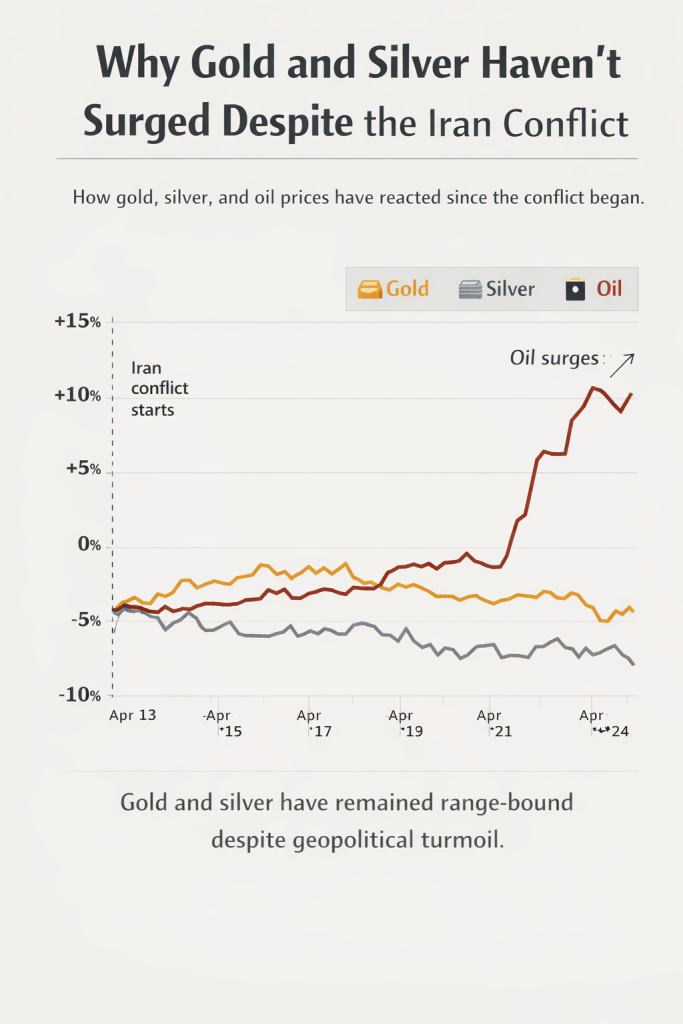
Why Gold and Silver Haven’t Surged Despite the Iran Conflict

Geopolitical turmoil, such as the recent escalation in the Iran war, often drives investors toward traditional safe-haven assets like gold and silver. Yet, despite attacks on ships in the Strait of Hormuz and rising oil prices, precious metals haven’t seen the dramatic spike many expected. Understanding why requires a closer look at both market psychology and broader economic factors.


📉 The Safe-Haven Puzzle

Gold and silver typically gain when investors seek protection from:

  • Geopolitical risk
  • Currency devaluation
  • Inflation concerns

However, the current market is showing a muted reaction. Prices for gold and silver remain largely range-bound, even as energy markets and equities react to the Middle East conflict.


🔹 Key Factors Suppressing Precious Metals

  1. Strong U.S. Dollar
    Despite the war, the U.S. dollar has strengthened. A stronger dollar makes gold and silver more expensive for holders of other currencies, reducing demand.
  2. Inflation vs. Interest Rates
    Inflation is rising due to energy costs, but central banks are still maintaining relatively high interest rates. Higher rates increase the opportunity cost of holding non-yielding assets like gold and silver.
  3. Risk Appetite in Other Assets
    Some investors are rotating into energy stocks or commodities that may benefit directly from higher oil prices rather than into metals. This has diverted capital away from gold and silver.
  4. Short-Term Market Sentiment
    Precious metals often react to immediate, tangible shocks—like a sudden currency crisis or global financial panic. While the Iran conflict is serious, markets have priced in a gradual escalation, and interventions such as the IEA oil reserve release may reduce panic-driven buying.

🔹 Metals Outlook

Analysts suggest that if geopolitical tensions escalate further, or if energy-driven inflation pressures persist, gold and silver could still see a delayed surge. For now, though:

  • Prices remain range-bound
  • Safe-haven buying is tempered by strong dollar and higher rates
  • Market participants are weighing oil market profits versus traditional hedges

📊 Bottom Line

Gold and silver are not always the immediate beneficiaries of geopolitical turmoil. Current economic conditions—strong dollar, elevated interest rates, and alternative avenues for hedging—are suppressing the metals’ typical reaction to risk.

Investors looking for safe havens may need to wait for further escalation or clear signs of economic stress before metals see a meaningful rally.


How Iran’s Attacks in the Strait of Hormuz and Record Oil Reserve Releases Are Shaking Global Markets

The past week has delivered some of the most dramatic swings in energy and financial markets in years. As Iran ramps up attacks on commercial vessels in the Strait of Hormuz—a waterway that normally handles about 20% of global oil shipments—oil markets have rocketed, some producers have cut output, and governments have responded with unprecedented intervention.


🛢️ Oil Markets: Prices Up, Volatility Up

Despite a historic intervention by the International Energy Agency (IEA) to release 400 million barrels from global strategic reserves—the largest such release in history—oil prices have remained elevated and volatile. Crude benchmarks like Brent have traded above $90–$100 per barrel as supply fears persist.

This demonstrates two key points:

  1. Reserve releases temper extreme price spikes, but they cannot fully offset sudden disruptions.
  2. Markets are pricing in a significant risk premium because the Strait of Hormuz remains threatened and regional energy infrastructure is under attack.

⚓ The Strait of Hormuz: A Choke Point With Global Reach

The Strait of Hormuz is a critical artery for global oil. Any disruption affects not only Iranian exports but also supplies from Saudi Arabia, Iraq, Kuwait, and the UAE. Even temporary interruptions trigger rapid price swings as traders hedge for worst-case scenarios.


📉 Broader Market Impact

  1. Stock markets have wobbled — global equity indexes dipped as oil prices surged and inflation fears grew. Energy costs affect transportation, manufacturing, airlines, and logistics.
  2. Supply chains beyond energy are strained — freight disruptions and rising shipping costs ripple through global commodity flows.
  3. Safe-haven assets are in demand — investors rotate into bonds, gold, and other low-risk assets during periods of uncertainty.

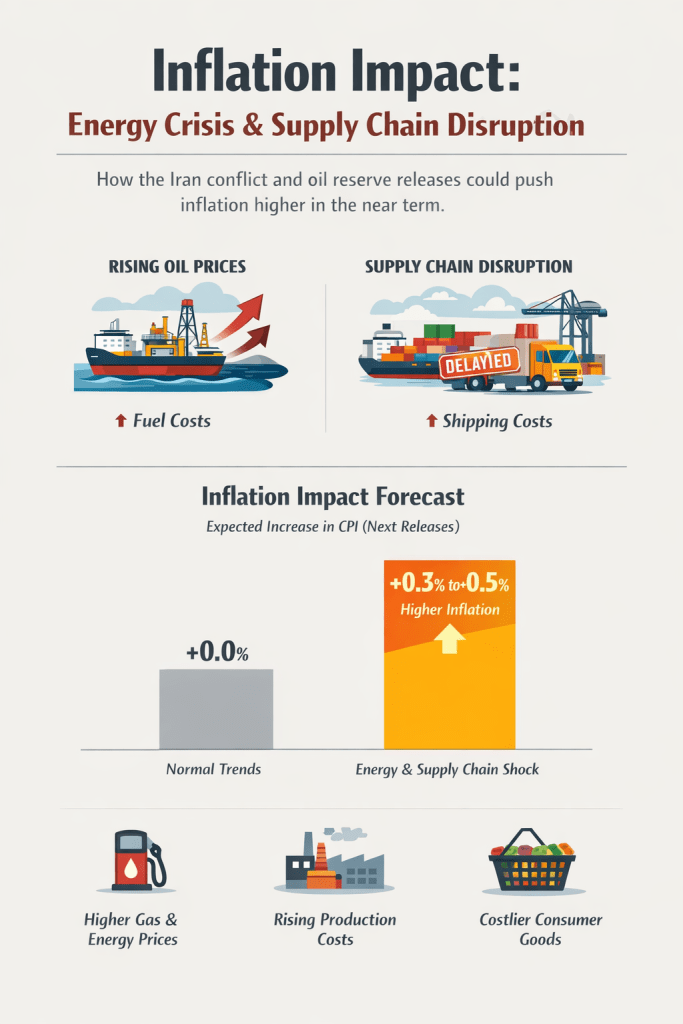
💹 Inflationary Pressure Forecast

The combination of elevated oil prices and disrupted shipping routes is expected to push inflation higher in the near term. Key points:

  • Transportation costs rise as shipping becomes riskier and fuel prices climb.
  • Goods production costs increase because petroleum-based inputs for manufacturing and chemicals become more expensive.
  • Consumer prices for energy and essential goods are likely to increase in the coming months, adding pressure on headline inflation.

Analysts forecast that inflation readings could be 0.3–0.5% higher than baseline expectations in the next CPI releases, primarily driven by energy and transportation costs. Central banks may respond cautiously, weighing both the temporary nature of the shock and the risk of broader economic slowing.


🧠 What the IEA Release Really Means

The coordinated release of 400 million barrels is extraordinary:

  • Provides near-term supply relief
  • Signals global policymakers are taking the energy shock seriously
  • Demonstrates international cooperation in a global energy crisis

However, markets see it as a stabilizing buffer, not a permanent solution. If attacks in the Strait of Hormuz continue, oil supply shocks and inflationary pressures are likely to persist.


📊 In Summary

With Iran attacking ships in the Strait of Hormuz and a record oil reserve release underway, markets are reacting on multiple fronts:

  • Oil prices remain elevated and volatile.
  • Equity markets are cautious due to inflation and growth concerns.
  • Supply chain costs beyond energy are climbing.
  • Inflationary pressure is expected to rise in the near term.

Even with strategic reserve releases, the uncertainty surrounding shipping lanes and regional energy security will keep markets headline-driven in the coming weeks.


Market Watch: Iran’s Leadership Shift and Ongoing Conflict Stir Volatility

Recent developments in the Middle East are keeping global markets on edge. Iran has appointed Mojtaba Khamenei, the son of the late Supreme Leader Ali Khamenei, as its new Supreme Leader, while military tensions in the region continue. These twin events—leadership succession and ongoing conflict—are injecting heightened uncertainty into financial markets worldwide.

A Hardline Leader in a Volatile Time

Mojtaba Khamenei’s rise is controversial. While state media highlight strong support, domestic sentiment appears deeply divided. Many observers caution that the new leadership is inexperienced and unlikely to pursue compromise, signaling that the current regional instability may persist. International reactions have been critical, adding layers of geopolitical tension.

How Markets Are Reacting

Markets generally dislike uncertainty, and geopolitical conflicts are no exception. The combination of ongoing military action and a potentially hardline Iranian leadership is creating a risk-off environment. Investors are moving cautiously, seeking safe havens such as bonds, gold, and other traditionally lower-risk assets.

Energy and defense sectors are seeing relative interest as investors anticipate potential disruptions in the Middle East. At the same time, volatility indices are elevated, reflecting broader concerns about global economic stability.

Key Factors to Watch

  • Conflict Escalation: Any expansion of the war or involvement of additional countries could heighten market stress.
  • Energy Prices: Spikes in oil or gas prices can feed inflation and slow growth, affecting investor sentiment.
  • Supply Chain Stability: Disruptions in global trade due to conflict can ripple through multiple industries.
  • Investor Psychology: Markets often price in worst-case scenarios early; sentiment can swing quickly if news suggests de-escalation.

Bottom Line

While markets may experience bouts of volatility in the near term, much depends on how the conflict evolves and whether diplomatic solutions emerge. Investors are watching closely, balancing risk against broader economic fundamentals. In times like these, uncertainty reigns—but so too does opportunity for those keeping a careful eye on global developments.


How Geopolitical News Moves Financial Markets: Lessons from the Iran War Headlines

Financial markets often react instantly to geopolitical developments. When conflicts escalate—or when there are signals that tensions may ease—investors rapidly reassess risk, energy supply, and economic outlook.

A clear example occurred today after comments from Donald Trump suggesting the war involving Iran could be nearing its conclusion. The remarks triggered sharp movements across stocks, oil markets, and other assets, illustrating how sensitive global markets are to geopolitical news.

A Sudden Market Reversal

Earlier in the day, markets were under pressure due to rising energy prices and fears of prolonged conflict. Oil had surged above $100 per barrel amid concerns that fighting in the region could disrupt supplies moving through key shipping routes.

However, sentiment shifted dramatically after Trump indicated that the conflict was “very far ahead of schedule” and could soon be completed. Investors quickly interpreted the comments as a sign that the war might end sooner than expected. (uk.finance.yahoo.com)

As a result:

  • Major U.S. stock indexes reversed earlier losses and moved higher.
  • Oil prices fell sharply after earlier spikes.
  • Risk appetite returned across financial markets.

The late-day rally highlighted how quickly markets can change direction when new information alters investors’ expectations.

Why War and Peace Affect Markets

Geopolitical conflicts influence markets through several key channels.

Energy Supply and Oil Prices

The Middle East plays a critical role in global energy supply. Much of the world’s oil flows through the Strait of Hormuz, a narrow but vital shipping route. When tensions rise in the region, investors fear that oil shipments could be disrupted.

Those fears drove oil prices sharply higher earlier during the Iran conflict. When the possibility of de-escalation emerged, crude prices quickly dropped as the perceived supply risk eased. (Forbes)

Lower energy prices can also support the broader economy by reducing inflation pressures and lowering costs for businesses and consumers.

Investor Risk Sentiment

Wars tend to push investors toward safer assets such as commodities, government bonds, and defensive sectors. The possibility of peace, on the other hand, often encourages investors to move capital back into equities and growth-oriented investments.

That shift in sentiment was visible in the rapid rebound of the S&P 500 and exchange-traded funds such as the SPDR S&P 500 ETF Trust following Trump’s remarks.

Late-Day Volatility

Large moves related to news often occur late in the trading session. Several factors can amplify these reactions:

  • Short sellers closing positions after sudden positive news
  • Institutional investors adjusting portfolios before the market close
  • Options-related hedging activity that accelerates price movements

These forces can create rapid spikes or reversals during the final hour of trading.

The Bigger Picture

Markets are forward-looking. Investors constantly evaluate how new information could change the trajectory of economic growth, energy prices, and geopolitical stability.

While a statement suggesting the end of a war can spark an immediate rally, markets ultimately respond to confirmed developments rather than speculation alone. Investors will continue watching for official ceasefire agreements, stability in energy markets, and long-term geopolitical outcomes.

The events surrounding today’s announcement provide a powerful reminder: in modern markets, geopolitical headlines can move billions of dollars in seconds—and understanding the economic mechanisms behind those moves helps investors make sense of sudden volatility.

Trump Declares 4 More Weeks of War with Iran

Here’s the latest market outlook now that President Trump has said the U.S.–Iran military campaign could continue for roughly another 4 weeks — and how markets are likely to respond in the near term and over that timeframe:


📊 Immediate Market Environment — Risk Off, Volatility Up

Right now markets are behaving in a typical geopolitical-conflict pattern:

  • Stocks and risk assets have pulled back, with U.S. and Asian equities generally lower and futures weakening as traders price in risk and uncertainty. Safe havens are attracting flows. (AP News)
  • Oil prices have jumped sharply, reflecting fears that conflict could disrupt Middle East supply — especially around the critical Strait of Hormuz. (Reuters)
  • Gold and silver are rallying as investors shift capital toward assets that preserve value during uncertainty, rather than assets tied to economic growth. (AP News)

This is classic risk-off behavior: equities soften, commodities with fear premiums rise, and safe-haven assets outperform.


🟡 Over the Next 1–4 Weeks: What Markets Are Most Likely to Do

🛢 Oil — the key driver

  • Analysts expect a near-term spike toward $80 per barrel or beyond if hostilities persist, with some scenarios pricing Brent even closer to ~$100 / barrel if supply disruptions appear real. (The National)
  • If Middle Eastern shipping remains disrupted or Iran retaliates strongly, volatility in energy markets will stay elevated. Higher energy costs can feed into inflation globally.

👉 Market implication:
Persistent high oil → higher inflation expectations → more pressure on equities and higher energy stock valuations.


🟡 Gold & Silver — Safe Haven Premium

  • With conflict ongoing and geopolitical risk priced in, gold and silver prices are likely to stay elevated through the conflict timeline — especially if oil stays high and volatility remains high. (The Business Standard)
  • Investors often increase allocations to precious metals during wars or extended uncertainty periods, and that dynamic looks firmly in play now.

Short-term trends:

  • Gold prices could remain strong or climb further as inflation, uncertainty, and risk premia heighten.
  • Silver tends to be more volatile but often outperforms gold on the upside when fear premia dominate.

📉 Equities — Pressure With Intermittent Bounces

  • Broad stock indexes are being weighed down by geopolitical risk, and analysts expect risk-off sentiment to persist as long as the conflict outlook remains unresolved. (Outlook Business)
  • Sectors that may outperform include defense, energy, and commodities. Conversely, technology, travel, and consumer discretionary stocks may underperform.

📈 Volatility & Safe Havens

  • Volatility indexes (like the VIX) tend to rise materially during multi-week conflict phases, reflecting uncertainty.
  • Investors often rotate into US Treasuries, gold, and the U.S. dollar, which are seen as shelters during geopolitical stress. (The Business Standard)

🧠 Putting It Together: 4-Week Outlook Summary

Near-term (next few days):
✔ Oil surges & fear premia dominate
✔ Stocks soften on heightened uncertainty
✔ Gold and silver rally

1–4 weeks:
✔ Gold and silver likely remain elevated or higher as conflict risk persists
✔ Oil may spike further if supply channels stay disrupted
✔ Equities could see sharp whipsaws, with defensive sectors outperforming
✔ Volatility likely to remain elevated

Key risk drivers to watch:

  • Strait of Hormuz activity: disruption here sends oil and inflation expectations much higher
  • Iranian retaliation intensity: the bigger and broader the retaliation, the stronger the safe-haven bid
  • Political and economic fallout: inflation pressures could influence central bank policy

📌 Bottom Line

A statement extending a military campaign for weeks isn’t just political — it’s a market signal that uncertainty will persist. That:

  • Boosts safe havens like gold and silver
  • Keeps oil prices high or volatile
  • Pressures risk assets like stocks in the short to medium term
  • Supports defensive sectors (energy, defense) over cyclical ones