Market Effects of a Potential Fed Rate Cut

A Fed rate cut is one of the most powerful policy levers in markets. Here’s a breakdown of how it tends to affect different parts of the financial system — and why September’s potential cut is being watched so closely:


📊 1. Stock Market

  • Bullish for equities (in theory):
    • Lower borrowing costs → boosts corporate profits.
    • Higher valuations as future earnings are discounted at lower rates.
    • Rate-sensitive sectors (tech, housing, utilities) usually rally.
  • Caution:
    • If the Fed is cutting because the economy is weakening, stocks may struggle (a “bad news = bad news” scenario).

💵 2. Bond Market

  • Treasury bonds: Prices rise, yields fall as investors anticipate easier policy.
  • Corporate bonds: Borrowing costs decline → better conditions for refinancing debt.
  • Yield curve: Cuts often steepen the curve (short-term yields fall faster than long-term).

💲 3. U.S. Dollar (Forex)

  • Lower rates make U.S. assets less attractive → dollar typically weakens.
  • A weaker dollar benefits exporters and multinational companies.

🪙 4. Gold & Commodities

  • Lower yields reduce the opportunity cost of holding gold → bullish for gold.
  • Weaker dollar also lifts commodities priced in dollars (oil, metals, agriculture).

🏠 5. Housing & Real Economy

  • Mortgage rates fall → more affordability for buyers, possible rebound in housing demand.
  • Businesses face lower financing costs → more capital spending.
  • Consumers pay less on credit cards, auto loans → improved spending power.

⚖️ Market Context Right Now (Sept 2025)

  • Why the Fed might cut: Weak jobs report (22k jobs added, rising unemployment), slowing housing market, cooling inflation.
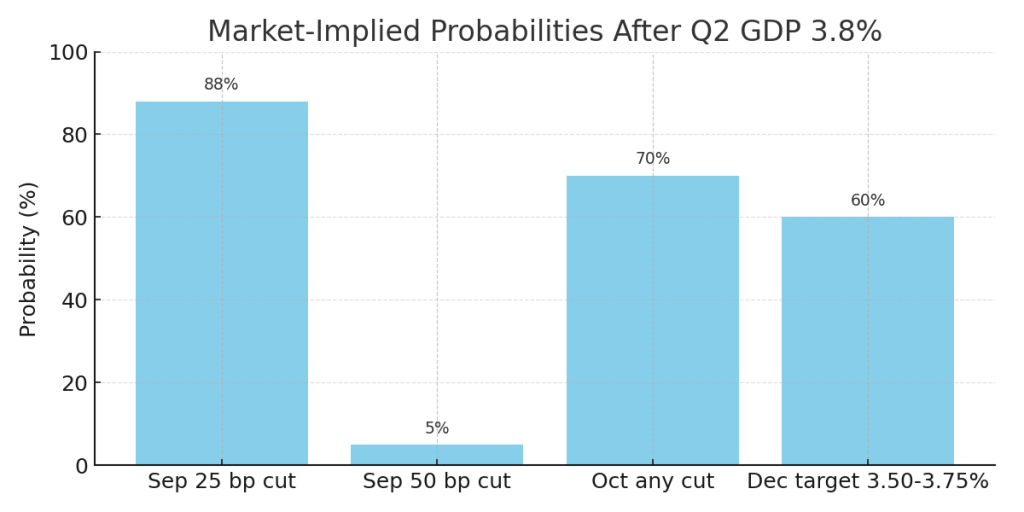
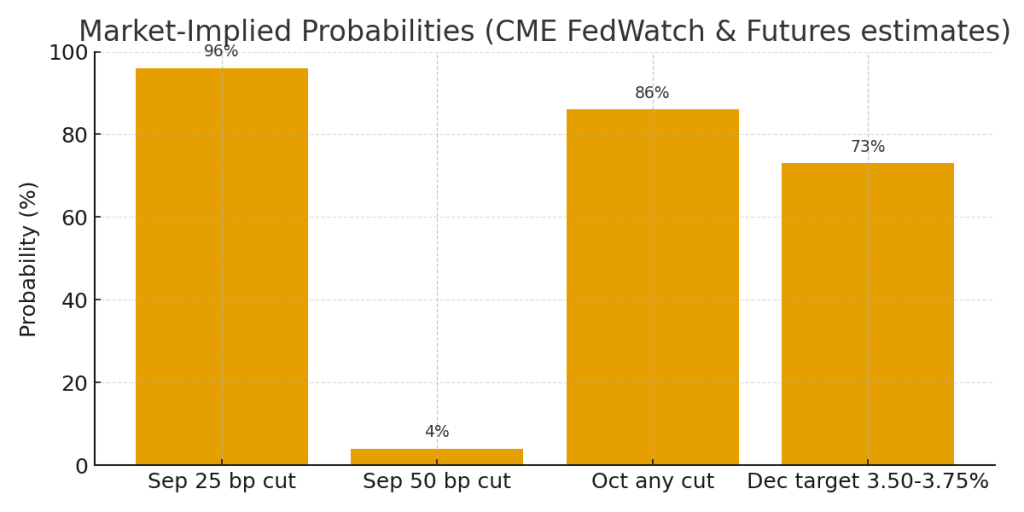
  • What’s priced in: Markets expect at least 25 bps, some betting on 50 bps.
  • Risk: If cuts are seen as a response to serious economic weakness, the initial rally could fade as recession fears rise.

Bottom line:

  • A Fed cut usually boosts stocks, bonds, and gold while weakening the dollar.
  • The market’s reaction depends on the narrative:
    • “Soft landing” → bullish (rate cuts extend growth).
    • “Hard landing” → bearish (cuts can’t stop a slowdown).

📊 Fed Rate Cut Scenarios & Market Impact

Fed Decision (Sept 2025)StocksBonds (Yields)U.S. DollarGold & CommoditiesNarrative / Market Mood
25 bps cut (base case)📈 Mild rally, especially in tech, housing, utilities. Banks mixed.Yields drift lower (esp. 2-yr). Curve steepens slightly.Weakens modestly.Gold up modestly, oil supported by weaker dollar.“Measured easing” → soft landing hopes.
50 bps cut (dovish surprise)🚀 Strong rally in growth stocks & housing. Cyclicals mixed (fear of slowdown).Yields plunge, bonds surge.Weakens sharply.Gold spikes toward new highs; commodities broadly higher.“Emergency cut” → could cheer markets short-term but raise recession concerns.
No cut (hawkish surprise)📉 Stocks drop, esp. rate-sensitive tech & REITs.Yields jump higher; bond selloff.Strengthens sharply.Gold falls; oil down on stronger dollar.“Fed behind the curve” → risk-off, higher volatility.

⚖️ How to Read This

  • 25 bps cut: Easiest for markets to digest — dovish enough to support assets, not panicky.
  • 50 bps cut: Big near-term boost for risk assets (stocks, gold), but raises questions: Is the economy worse than expected?
  • No cut: Would shock markets — likely selloff across stocks and bonds, stronger dollar, and higher volatility.

Bottom line:

  • If the Fed cuts 25 bps, markets rally steadily.
  • If it cuts 50 bps, markets pop big but may wobble as traders debate “hard landing” risk.
  • If no cut, expect a sharp correction.

Here’s the sector-by-sector breakdown for each Fed rate cut scenario at the September meeting:


🏦 Sector Playbook: Fed Cut Scenarios

Fed DecisionTech (AI, semis, cloud)Financials (banks, insurers)Housing / REITsEnergy / CommoditiesDefensives (healthcare, utilities, staples)
25 bps cut (base case)🚀 Boosted (lower discount rates, cheaper capital).Mixed — loan margins shrink, but stable outlook.📈 Positive — lower mortgage rates spur demand.Mildly positive from weaker dollar.Stable, modest gains.
50 bps cut (dovish surprise)🚀🚀 Big rally — growth stocks thrive.😬 Negative — sharp margin compression, signals weak economy.🚀 Strong rebound — mortgages cheaper, REITs soar.Commodities rally (weak USD), but recession fears cap oil.📈 Strong bid as investors hedge slowdown risk.
No cut (hawkish surprise)📉 Sharp selloff — most sensitive to higher rates.📈 Positive for banks (wider margins), insurers benefit.📉 Hit hard — housing demand weakens.Oil & commodities fall on strong dollar.📈 Attract flows as safe havens.

⚖️ Key Insights

  • Tech & Housing = biggest winners if the Fed cuts.
  • Banks: Do best if no cut (higher margins), but struggle under larger cuts.
  • Energy: Moves more with global demand; a weaker dollar supports oil & metals, but slowdown risk offsets.
  • Defensives: Attract flows in both 50 bps cut (recession fears) and no cut (risk-off) scenarios.

Bottom Line:

  • 25 bps cut → Balanced bullishness. Tech + housing lead, market stable.
  • 50 bps cut → Explosive rally in growth/housing, but signals possible recession → defensives also rise.
  • No cut → Tech & housing slump, banks & defensives outperform.

📊 Fed Rate Cut Scenarios: Full Portfolio Impact

Fed DecisionStocksBonds – Short-Term (2Y)Bonds – Long-Term (10Y+)U.S. DollarGold & CommoditiesMarket Mood
25 bps cut (base case)📈 Mild rally (tech + housing strongest).📉 Yields fall modestly → prices rise.📉 Yields edge lower → curve steepens slightly.Weaker, but not sharply.Gold + commodities tick higher.“Soft landing still alive.”
50 bps cut (dovish surprise)🚀 Growth stocks + REITs surge; banks pressured.📉📉 Yields plunge — bonds rip higher.📉 Yields drop, but less than 2Y → strong steepening.Sharp weakening.Gold spikes 🚀; oil + metals rise.“Emergency easing” → short-term euphoria, recession worries linger.
No cut (hawkish surprise)📉 Selloff — tech + housing hit hardest.📈 Yields jump — bonds sell off.📈 Yields rise, but less than 2Y → curve flattens.Dollar strengthens strongly.Gold + commodities drop.“Fed behind the curve” → risk-off, volatility spike.

⚖️ Bond Market Mechanics

  • Short-term bonds (2Y) move most with Fed expectations. Cuts → strong rally; no cut → steep losses.
  • Long-term bonds (10Y+) move more with growth/inflation outlook. Cuts steepen curve (2Y down faster), while no cut flattens curve.
  • Steepening curve → suggests policy easing; flattening → markets fear growth slowdown or tight policy.

Big Picture Takeaway

  • 25 bps cut: Best-case balance → steady stock rally, moderate bond gains, stable dollar weakness.
  • 50 bps cut: Short-term party for stocks, bonds, and gold, but could spark “Why so aggressive?” recession fears.
  • No cut: Risk-off across equities/commodities, bonds and dollar diverge (bonds down, USD up).

Market impact on latest housing data

Latest housing data shows more sellers than buyers.

This signals an imbalance in the real estate market that can ripple out into the broader economy and financial markets. Here’s how it can play out:


🏠 Housing Market Dynamics

  • Excess supply vs. demand → home prices fall or stagnate.
  • Buyers hold back, anticipating lower prices later.
  • Sellers may be forced to cut prices, accept longer time-to-sell, or pull listings.

📊 Broader Market Impacts

1. Consumer Wealth & Spending

  • Housing is the largest asset for most households.
  • Falling home prices = negative wealth effect → consumers feel poorer, spend less on retail, travel, durable goods.
  • This can slow GDP growth.

2. Construction & Jobs

  • If homes sit unsold, builders slow new projects.
  • That hits construction jobs, suppliers (lumber, steel, appliances), and related industries.
  • Weaker housing demand can worsen an already slowing labor market.

3. Banking & Credit

  • Mortgage activity slows → banks earn less from originations/refinancing.
  • Falling home values raise credit risks (especially for regional banks exposed to real estate lending).
  • May tighten credit conditions across the economy.

4. Inflation & Fed Policy

  • Housing (shelter) makes up a big chunk of CPI.
  • More sellers than buyers = downward pressure on rents and home prices → eases inflation.
  • Could give the Fed more room to cut rates.

5. Stock Market Sectors

  • Bearish impact: Homebuilders, REITs, building materials, mortgage lenders.
  • Potentially bullish: Rate-sensitive sectors (tech, utilities) if Fed cuts sooner in response.

⚖️ Bottom Line

  • Short-term: Rising supply vs. weak demand in housing pressures home prices, dampens consumer confidence, and weighs on housing-related stocks.
  • Medium-term: If it eases inflation, it could accelerate Fed rate cuts, which may help broader equities and bonds.
  • Risk: If housing weakness deepens, it can spill into banking and consumption, raising recession risks.

How will the recent job report affect the markets

Here’s how the August U.S. jobs report shook up the markets and what it means going forward:


Key Takeaways from the Job Report

Weakest Job Growth in Years

  • In August, the U.S. added just 22,000 jobs, a stark miss compared to the ~75,000 forecast and a sharp slowdown from earlier months.
  • June’s data was revised into a 13,000 job loss, marking the first decline since 2020.
  • The unemployment rate rose to 4.3%, the highest since 2021.
  • Manufacturing continues to struggle, shedding jobs for four months in a row.

Market Reactions & Investor Sentiment

Equities

  • Initial uplift: Stock futures rose as weaker job data reinforced expectations for a Fed rate cut.
  • Volatility kicked in: Though equities briefly neared record highs, markets pulled back as the weakness raised broader slowdown concerns.

Bonds & Yields

  • Yields plunged:
    • 2-year Treasury yield dropped to around 3.47%.
    • 10-year yield fell to roughly 4.07%, nearing April lows.
  • Investors rushed into Treasuries, signaling strong demand for safer assets.

U.S. Dollar & Gold

  • Dollar weakened, reflecting lower interest rate expectations.
  • Gold soared, hitting new highs near $3,600/oz, driven by rate-cut expectations and safe-haven flows.

Fed Rate Cut Expectations

  • Markets now strongly expect a September rate cut, with many pricing in a 25-basis-point cut and some even betting on a 50-basis-point move.

Summary Table

Asset / IndicatorMarket Reaction / Outlook
StocksBrief rally then retraction; mixed sentiment persists.
Bonds (Yields)Yields tumbled as investors anticipated Fed easing.
U.S. DollarWeakened amid outlook for softer monetary policy.
GoldSurged to new highs on safe-haven demand and rate cut bets.
Fed PolicyRate cut in September now almost certain; some expecting larger movement.

Bottom Line

The soft August jobs report has reinforced the narrative that the labor market is cooling—which the Fed is unlikely to ignore. While markets were initially buoyed by rate-cut prospects, underlying economic concerns remain real. The bond market and gold responded strongly, while equity markets remain sensitive to incoming data and Fed signals.

Unemployed Exceeds Job Openings

For the first time since the COVID-19 pandemic, the number of unemployed people in the U.S. has exceeded the number of available job openings. In July 2025, job openings dropped to approximately 7.18 million, while the number of unemployed stood slightly higher at around 7.2 million.


What This Means

  • Labor Market Cooling: Traditionally, job openings outnumber unemployed individuals—a sign of a tight labor market with plenty of opportunities. This reversal signals a shift toward a cooler labor market with weaker demand for workers.
  • Fed Policy Implications: This cooling supports expectations that the Federal Reserve may cut interest rates soon, as a softer labor market raises concerns about slower economic growth.
  • Economic Drag Ahead: Fewer openings may reduce job mobility, slow wage growth, and limit opportunities for career advancement. Analysts describe this as “another crack in the labor market,” which could drag on consumer spending and overall economic vitality.

Quick Snapshot

MetricJuly 2025 (Approx.)
Unemployed Persons~7.2 million
Job Openings~7.18 million
OutcomeUnemployed > Openings

Sectoral Impact — Sectors Most Affected (Falling Openings)

According to JOLTS and recent reports:

    Healthcare & Social Assistance

    Saw a notable decline in job openings in July, despite historically strong demand in this sector.

    Retail Trade

    Also recorded a pullback in vacancies in July, contributing to the broader opening-end unemployment crossover.

    Accommodation & Food Services (Hospitality)

    Experienced one of the largest month-to-month falls in opening counts—down by around 308,000 in June.

    Construction

    Continues to struggle, with openings declining (e.g., –38,000 in March). It also hit the lowest hiring rate on record in March.


    Sectors Holding Up Relatively Better

    • Retail Trade (May boost)
      • While retail saw declines later, May saw a +190,000 increase in openings. This suggests some volatility and sector-specific timing differences.
    • Manufacturing
      • Exhibited small gains earlier in the year (+4,000 openings in March).
      • But longer-term trends and job losses (e.g., in July’s payroll data) indicate deeper weaknesses in manufacturing hiring over time.

    Summary Table: Sector Snapshot

    SectorRecent Trend in Job Openings
    Healthcare & Social AssistanceSharp decline in July—major past demand now cooling
    Retail TradeDecline in July openings; volatile gains in May
    Hospitality (Food & Accomm.)Big drop in openings (~308k decline in June)
    ConstructionOngoing struggle—falling openings and lowest hires rate
    ManufacturingSlight gains earlier, but broader weakness rising

    Key Takeaways

    • Sectors like healthcare, retail, hospitality, and construction are experiencing sharper drops in recruitment and openings, likely reflecting weakening demand and economic caution.
    • Manufacturing shows a more mixed trend—modest openings earlier but tempered by recent job cuts and macro pressures.
    • Even once-robust sectors like healthcare are now cooling, which underscores the breadth of the labor slowdown.

    Bottom Line

    There are now more unemployed Americans than job openings, marking a notable shift in the U.S. labor market. It reflects cooling conditions, reinforces expectations for rate cuts, and raises concerns about a slowdown in job creation and consumer strength.


      What does the US Gov’t recent stake in Intel mean?

      Here’s an updated breakdown of what the U.S. government’s 10% stake in Intel means—from both strategic and market perspectives:


      What Just Happened?

      • As part of a broader deal under the CHIPS and Science Act, the U.S. government converted approximately $11.1 billion in previously awarded grants into equity, acquiring about a 9.9% stake in Intel via a discounted share purchase at $20.47 each. The ownership is structured to be passive, meaning no board seats or governance rights, and the government will generally vote in line with Intel’s management, barring exceptions. Additionally, there’s a 5-year warrant to gain another 5% stake if Intel’s foundry ownership falls below 51%.

      Strategic and Economic Implications

      1. Protecting Intel’s Foundry Business

      The government’s investment is designed specially to prevent Intel from divesting or spinning off its struggling foundry division—which lost about $13 billion in 2024—and ensure it remains committed to domestic chip manufacturing.

      2. Domestic Manufacturing & National Security

      By injecting capital into Intel, the U.S. is reinforcing semiconductor sovereignty—reducing reliance on offshore providers and supporting chip production vital for AI, defense, and emerging tech infrastructure.

      3. Market Signal and Stability

      Despite Intel’s financial struggles, the equity infusion reduces uncertainty around funding, providing a confidence boost to investors and likely stabilizing the stock—which in fact appreciated by nearly 7–8% on announcement.

      4. Potential Risks & Critiques

      • Market Distortion: Economists argue that direct government stakes in corporations could blur lines between public and private sectors, risking crony capitalism or reduced competitive incentives.
      • Dilution & Shareholder Friction: Existing shareholders face dilution. Though the government pledged to vote with the company, there are concerns about long-term investor trust and independence.
      • International Optics: Partners outside the U.S. may question Intel’s neutrality, given partial federal ownership.

      Bottom Line Summary

      AspectImplication
      Equity Stake~9.9% passive, with optional 5% warrant; no governance control.
      Financial ReliefConverts commitments into capital—provides stability to Intel.
      Strategic AssuranceLocks in support for foundry operations and U.S. manufacturing.
      Market SentimentStock rebounded; signals long-term backing and reduces political uncertainty.
      Concerns RaisedRisk of market distortion, diluted governance, and eroded investor trust.

      How will this affect TSM, AMD, and other chip manufacturers?


      🌎 Global Impacts of U.S. Funding Intel

      1. Pressure on TSMC (Taiwan)

      • Market Share Risk: TSMC currently dominates 90% of the world’s most advanced chips (3nm & below). Intel’s expansion threatens to claw back U.S. market share over time.
      • Geopolitical Pressure: The U.S. sees TSMC’s location in Taiwan as a strategic vulnerability. Intel’s domestic fabs are meant to reduce reliance on Taiwan, which could shift long-term contracts (especially defense & AI) from TSMC → Intel.
      • Talent & Tech Race: Intel is racing to catch up in process nodes (2nm, 1.8nm) where TSMC leads. Government backing helps close that gap faster.

      2. Samsung (South Korea)

      • Samsung is a rival in both memory chips and logic/foundry.
      • U.S. subsidies to Intel may push Samsung to secure more South Korean or U.S. incentives to stay competitive.
      • Samsung already has fabs in Texas, so this could increase U.S. reliance on Samsung too, but Intel is positioned as the primary U.S. champion.

      3. Other U.S. Chip Companies (AMD, NVIDIA, Qualcomm)

      • They don’t manufacture chips themselves — they design and outsource (mostly to TSMC).
      • If Intel’s foundry services (IFS) improve, these companies might shift some production from TSMC → Intel, creating competition.
      • Short-term: Intel still lags TSMC on yield & cost.
      • Long-term: With subsidies, Intel could undercut pricing to win contracts.

      4. European & Chinese Chipmakers

      • Europe (ASML, STMicro, Infineon): They benefit indirectly — U.S. fab expansion = more equipment sales.
      • China (SMIC, Huawei): U.S. is actively trying to limit China’s chip growth with export bans. By pumping Intel, the U.S. is reinforcing a tech blockade strategy against China.

      📊 Financial Market Outcomes

      • Intel: Viewed as having a U.S. “safety net” → less bankruptcy risk, more R&D power → bullish long-term, though execution risk remains.
      • TSMC: Still king in the short term, but investors may price in future U.S. capacity competition. Also, any Taiwan–China tensions now matter even more.
      • Samsung: Neutral-to-positive; competition heats up, but also pushes more subsidies their way.
      • Chip Equipment Makers (ASML, Applied Materials, Lam Research): Big winners → more fabs = more equipment demand worldwide.

      Bottom Line:
      This U.S. “10% of Intel” investment is less about helping one company and more about reshaping the global chip supply chain. It:

      • Reduces reliance on TSMC/Taiwan (a geopolitical hedge).
      • Elevates Intel as the U.S. semiconductor champion.
      • Forces rivals (Samsung, TSMC) to push harder with subsidies and innovation to maintain their edge.

      Would you like me to create a side-by-side forecast of Intel vs. TSMC market share over the next 5 years, showing how this investment could shift their positions?

      Is the Market Slowing Down?

      The short answer: Yes, indicators are pointing to a slowdown, particularly in economic growth, hiring, and consumer sentiment—though not a full-blown recession yet.

      Signs of Economic Softness

      • The Federal Reserve’s Beige Book for late August points to a sluggish U.S. economy: slower hiring, cautious consumer spending, and persistent inflation pressure. Businesses are hesitant to refill vacant roles.
      • Businesses across most Fed districts report stagnant growth, with hiring freezes and rising prices affecting both demand and sentiment.
      • JP Morgan now estimates a 40% probability of recession by end of 2025, signaling elevated downside risks.
      • Conference Board projections: U.S. real GDP growth is expected to slow to 1.6% in 2025, slowing further to 1.3% in 2026, though no recession is projected yet.
      • St. Louis Fed data: Real GDP grew at an annualized 1.4% in H1 2025, modest and below long-term potential. The outlook for H2 remains moderate, with potential for recovery in 2026.

      Global Growth Is Under Strain

      • The IMF projects global growth to remain at about 3.2% in 2025, consistent with 2024 levels—a slower pace than pre-pandemic norms.
      • The World Bank has downgraded its global growth forecast to 2.3% in 2025, one of the weakest periods outside major recessions. This slowdown is driven by rising trade barriers and uncertainty.
      • However, some hope: Oxford Economics notes that business confidence is quietly rebounding. Global GDP could surpass 3% by mid-2026 if geopolitical risks ease and AI-driven investment picks up.

      Markets Reflect Caution and Fragility

      • Hedge funds are exhibiting risk aversion: many were net sellers in August amid fragile sentiment and seasonal volatility concerns for September.
      • Financial Times podcast warns of hidden risks: overvalued U.S. equities (especially tech and AI), inflows into private markets, and potential triggers like a hit to the Treasury market or excess in AI infrastructure.

      Summary Table

      AreaStatus
      Economic GrowthSlowing — GDP ~1.4% H1, forecasts ease into H2
      Labor MarketWeakening — slower hiring, elevated caution
      Consumer SpendingMuted — wary consumers, tariff-driven pressures
      Financial MarketsCautious — hedge funds scaling back, volatility rising
      Global TrendsDimming — low growth forecasts, but possible rebound by mid-2026

      Bottom Line

      The economy is indeed showing signs of a slowdown, particularly in hiring, consumption, and growth metrics. Markets are responding with increased caution, though a recession hasn’t fully materialized yet. The main question now is whether the slowdown is temporary—with policy levers and investment innovations setting the stage for a rebound—or if it deepens into something more prolonged.