Markets Whipsaw as Hot PPI Meets Fed Pause: What Today’s Data Really Means

Today delivered a one-two punch for markets: a closely watched Producer Price Index (PPI) report in the morning, followed by the Federal Reserve’s FOMC decision in the afternoon.

The result? A volatile session that reflected a market struggling to reconcile persistent inflation with a cautious central bank.


📊 Morning Shock: PPI Reinforces Inflation Concerns

The day started with the release of the latest PPI data at 8:30 AM ET—a key measure of wholesale inflation.

Recent trends have shown PPI coming in hotter than expected, with prior readings around +0.5% month-over-month vs. +0.3% expected, and core components even stronger. (XTB Broker Online)

That matters because PPI often feeds into future consumer inflation (CPI).

Today’s takeaway:

  • Inflation pressures—especially in services—remain sticky
  • The idea of quick rate cuts is fading
  • Markets immediately leaned risk-off

Historically, strong PPI prints tend to push equities lower because they signal the Fed may need to keep rates higher for longer.


🏛️ Afternoon: Fed Holds Rates, But Tone Matters

Later in the day, the Federal Open Market Committee (FOMC) announced its rate decision.

As expected, the Fed held rates steady in the 3.50%–3.75% range. (Wikipedia)

But the decision itself wasn’t the story—the messaging was.

Markets were focused on:

  • Future rate cut timing
  • Inflation outlook
  • Economic projections

Coming into the meeting, expectations were already shifting toward fewer or later rate cuts, especially after recent inflation data. (GO Markets)


📉 Market Reaction: A Tug-of-War Between Inflation and Policy

The market reaction today can be summed up in one word: conflicted.

After PPI:

  • Stocks moved lower
  • Yields and inflation fears rose
  • Rate-cut expectations were pushed further out

After FOMC:

  • Initial reaction depended on interpretation of Fed tone
  • Markets attempted to stabilize, but conviction remained low

This creates a classic push-pull dynamic:

  • Inflation data → bearish (higher rates longer)
  • Fed pause → mildly supportive (no immediate tightening)

⚡ The Bigger Picture: Why Today Matters

Today wasn’t just about one data point or one Fed meeting—it highlighted a broader market theme:

👉 The last mile of inflation is proving difficult.

  • Goods inflation is easing
  • Services inflation remains sticky
  • Energy prices (partly due to geopolitical tensions) add uncertainty

This combination makes the Fed’s job harder and keeps markets on edge.


🔮 What Comes Next

Markets are now recalibrating around a few key questions:

  • Will inflation stay elevated longer than expected?
  • Are rate cuts being pushed into the second half of the year?
  • Can the economy handle higher rates without slowing sharply?

Expect:

  • Continued volatility around economic data releases
  • Increased sensitivity to inflation prints
  • More choppy, headline-driven trading

✅ Bottom Line

Today’s market action reflects a simple but powerful reality:

  • Inflation is not fully under control
  • The Fed is in wait-and-see mode
  • Markets are adjusting to “higher for longer”

Until there is clearer evidence that inflation is cooling, expect markets to remain reactive, volatile, and highly data-dependent.
What to Watch in Tomorrow’s Economic News

Investors heading into Wednesday will be keeping a close eye on several key economic developments that could influence market sentiment throughout the day. From fresh inflation data in the morning to a highly anticipated Federal Reserve decision in the afternoon, tomorrow’s economic calendar has the potential to shape the direction of U.S. stocks.

Morning Focus: Inflation at the Wholesale Level

The first major report arrives at 8:30 AM Eastern Time with the release of the Producer Price Index (PPI). Published by the U.S. Bureau of Labor Statistics, this report measures changes in the prices businesses receive for their goods and services.

While consumers are often more familiar with the Consumer Price Index (CPI), the PPI provides an important early signal about inflationary pressures within the supply chain. When producer prices rise sharply, companies may eventually pass those costs along to consumers.

For investors, the implications are straightforward:

  • Higher-than-expected PPI: Signals rising inflation pressure, which can weigh on stocks if investors worry the Federal Reserve may keep interest rates higher for longer.
  • Lower-than-expected PPI: Suggests inflation may be easing, which can support equities and improve overall market sentiment.

Because the report is released before the market opens, it often influences futures trading and sets the tone for the opening bell.

Mid-Morning Data: Manufacturing Activity

Another report arrives later in the morning at 10:00 AM Eastern Time, offering insights into the health of the U.S. manufacturing sector. This data, published by the United States Census Bureau, tracks factory orders, shipments, and inventories.

Although it typically has a smaller impact than inflation reports, a significant surprise in the data can still move markets, especially if it suggests stronger-than-expected economic growth or a sudden slowdown in industrial activity.

The Main Event: The Federal Reserve Decision

The biggest event of the day comes in the afternoon when the Federal Reserve announces its latest interest rate decision at 2:00 PM Eastern Time following its policy meeting.

Markets will be watching closely for any signals about the central bank’s outlook on inflation, economic growth, and future rate policy. Shortly afterward, Federal Reserve Chair Jerome Powell will hold a press conference, where investors will listen carefully for clues about the path of monetary policy in the months ahead.

Why It Matters for Markets

Together, these events create a full day of potential market catalysts. Inflation data can influence expectations about future interest rate decisions, while manufacturing data offers a glimpse into the broader health of the economy.

Finally, the Federal Reserve’s announcement and commentary can reshape investor expectations in a matter of minutes, often triggering significant volatility across stocks, bonds, and commodities.

For investors and market watchers alike, Wednesday promises to be a day where economic data and policy decisions could play a decisive role in shaping the market’s next move.

Will the Iran War Trigger a Petrodollar Exodus from U.S. Markets?

The recent escalation of the Iran conflict has raised a pressing question for investors: could Gulf oil-exporting nations pull their trillions of petrodollars out of U.S. markets? While the headlines may suggest a potential exodus, the reality is far more nuanced.


🛢️ What Are Petrodollars?

When countries like Saudi Arabia, the UAE, and Qatar sell oil, they are paid in U.S. dollars. These dollars are then reinvested globally through:

  • U.S. Treasury bonds
  • Equities
  • Real estate and private equity

This reinvestment process, called petrodollar recycling, has been a cornerstone of global finance for decades.


⚠️ Why Investors Are Watching Now

The Iran war has created geopolitical uncertainty in the Gulf, prompting some sovereign funds to review their global investment strategies. Funds such as:

  • Saudi Arabia Public Investment Fund (~$1.1T)
  • Abu Dhabi Investment Authority (~$1.1T)
  • Kuwait Investment Authority (~$1T)
  • Qatar Investment Authority (~$500B)

control trillions of dollars in assets—enough that even a small reallocation could move global markets.


💵 But There’s No Exodus… Yet

Despite heightened tensions:

  • There has been no major withdrawal from U.S. markets.
  • Gulf financial hubs like Dubai and Doha continue normal investment activity.
  • The U.S. dollar has actually strengthened, as investors flock to safe-haven assets.

Ironically, the uncertainty caused by the war often increases demand for U.S. assets, rather than decreasing it.


🔑 Why Gulf Funds Still Rely on U.S. Markets

Even with the conflict, the U.S. remains a preferred destination for petrodollars because:

  1. Liquidity: Few markets can absorb hundreds of billions of dollars.
  2. Tech and venture capital: Many high-return opportunities are U.S.-based.
  3. Dollar-denominated oil trade: Accumulated dollars must be reinvested somewhere.

⚡ When Could a Real Exit Happen?

A major petrodollar withdrawal is unlikely without significant geopolitical shifts, such as:

  • A collapse of Gulf-U.S. security alliances
  • A shift of oil trade to currencies like the Chinese yuan
  • Targeted sanctions or restrictions on Gulf assets

Until then, any movement is likely to be gradual diversification, not a sudden pullout.


🌍 The Real Trend: Diversification, Not Abandonment

Gulf sovereign funds are increasingly diversifying into:

  • China and India
  • Southeast Asia
  • Europe
  • Domestic megaprojects

This reduces dependence on U.S. markets while keeping the bulk of their petrodollars invested in safe, liquid assets.


✅ Bottom Line

The Iran war raises legitimate concerns about global capital flows. But historically and currently, there is no large-scale petrodollar exit from the U.S. In fact, uncertainty often drives more money into U.S. assets, not away.

For investors, the takeaway is clear: watch for gradual diversification trends, but don’t expect an immediate flood out of U.S. markets.

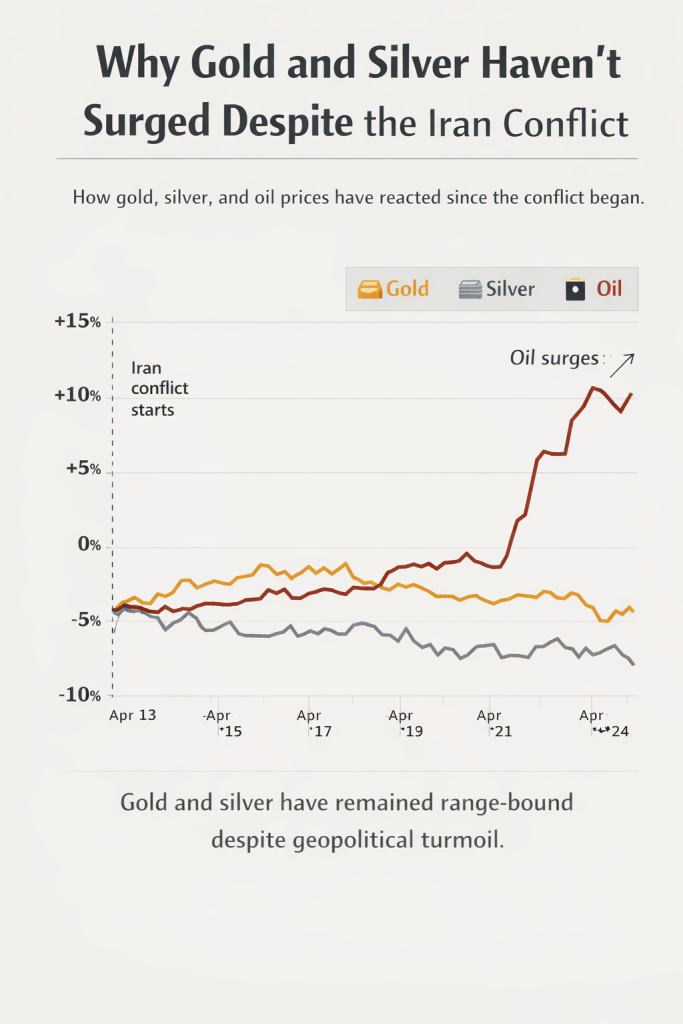
Why Gold and Silver Haven’t Surged Despite the Iran Conflict

Geopolitical turmoil, such as the recent escalation in the Iran war, often drives investors toward traditional safe-haven assets like gold and silver. Yet, despite attacks on ships in the Strait of Hormuz and rising oil prices, precious metals haven’t seen the dramatic spike many expected. Understanding why requires a closer look at both market psychology and broader economic factors.


📉 The Safe-Haven Puzzle

Gold and silver typically gain when investors seek protection from:

  • Geopolitical risk
  • Currency devaluation
  • Inflation concerns

However, the current market is showing a muted reaction. Prices for gold and silver remain largely range-bound, even as energy markets and equities react to the Middle East conflict.


🔹 Key Factors Suppressing Precious Metals

  1. Strong U.S. Dollar
    Despite the war, the U.S. dollar has strengthened. A stronger dollar makes gold and silver more expensive for holders of other currencies, reducing demand.
  2. Inflation vs. Interest Rates
    Inflation is rising due to energy costs, but central banks are still maintaining relatively high interest rates. Higher rates increase the opportunity cost of holding non-yielding assets like gold and silver.
  3. Risk Appetite in Other Assets
    Some investors are rotating into energy stocks or commodities that may benefit directly from higher oil prices rather than into metals. This has diverted capital away from gold and silver.
  4. Short-Term Market Sentiment
    Precious metals often react to immediate, tangible shocks—like a sudden currency crisis or global financial panic. While the Iran conflict is serious, markets have priced in a gradual escalation, and interventions such as the IEA oil reserve release may reduce panic-driven buying.

🔹 Metals Outlook

Analysts suggest that if geopolitical tensions escalate further, or if energy-driven inflation pressures persist, gold and silver could still see a delayed surge. For now, though:

  • Prices remain range-bound
  • Safe-haven buying is tempered by strong dollar and higher rates
  • Market participants are weighing oil market profits versus traditional hedges

📊 Bottom Line

Gold and silver are not always the immediate beneficiaries of geopolitical turmoil. Current economic conditions—strong dollar, elevated interest rates, and alternative avenues for hedging—are suppressing the metals’ typical reaction to risk.

Investors looking for safe havens may need to wait for further escalation or clear signs of economic stress before metals see a meaningful rally.


How Iran’s Attacks in the Strait of Hormuz and Record Oil Reserve Releases Are Shaking Global Markets

The past week has delivered some of the most dramatic swings in energy and financial markets in years. As Iran ramps up attacks on commercial vessels in the Strait of Hormuz—a waterway that normally handles about 20% of global oil shipments—oil markets have rocketed, some producers have cut output, and governments have responded with unprecedented intervention.


🛢️ Oil Markets: Prices Up, Volatility Up

Despite a historic intervention by the International Energy Agency (IEA) to release 400 million barrels from global strategic reserves—the largest such release in history—oil prices have remained elevated and volatile. Crude benchmarks like Brent have traded above $90–$100 per barrel as supply fears persist.

This demonstrates two key points:

  1. Reserve releases temper extreme price spikes, but they cannot fully offset sudden disruptions.
  2. Markets are pricing in a significant risk premium because the Strait of Hormuz remains threatened and regional energy infrastructure is under attack.

⚓ The Strait of Hormuz: A Choke Point With Global Reach

The Strait of Hormuz is a critical artery for global oil. Any disruption affects not only Iranian exports but also supplies from Saudi Arabia, Iraq, Kuwait, and the UAE. Even temporary interruptions trigger rapid price swings as traders hedge for worst-case scenarios.


📉 Broader Market Impact

  1. Stock markets have wobbled — global equity indexes dipped as oil prices surged and inflation fears grew. Energy costs affect transportation, manufacturing, airlines, and logistics.
  2. Supply chains beyond energy are strained — freight disruptions and rising shipping costs ripple through global commodity flows.
  3. Safe-haven assets are in demand — investors rotate into bonds, gold, and other low-risk assets during periods of uncertainty.

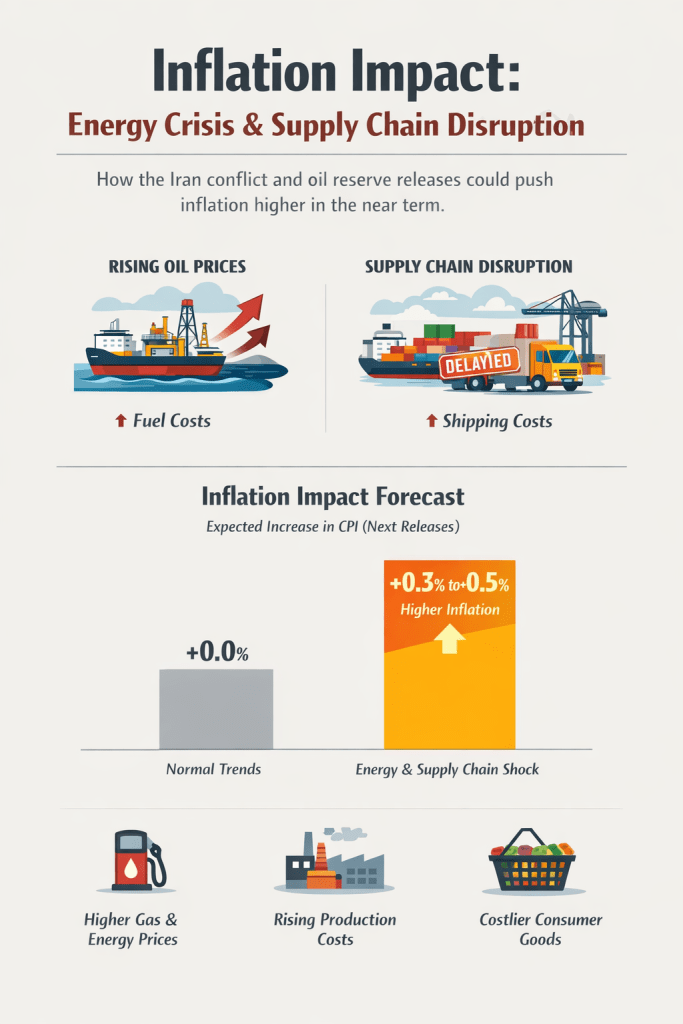
💹 Inflationary Pressure Forecast

The combination of elevated oil prices and disrupted shipping routes is expected to push inflation higher in the near term. Key points:

  • Transportation costs rise as shipping becomes riskier and fuel prices climb.
  • Goods production costs increase because petroleum-based inputs for manufacturing and chemicals become more expensive.
  • Consumer prices for energy and essential goods are likely to increase in the coming months, adding pressure on headline inflation.

Analysts forecast that inflation readings could be 0.3–0.5% higher than baseline expectations in the next CPI releases, primarily driven by energy and transportation costs. Central banks may respond cautiously, weighing both the temporary nature of the shock and the risk of broader economic slowing.


🧠 What the IEA Release Really Means

The coordinated release of 400 million barrels is extraordinary:

  • Provides near-term supply relief
  • Signals global policymakers are taking the energy shock seriously
  • Demonstrates international cooperation in a global energy crisis

However, markets see it as a stabilizing buffer, not a permanent solution. If attacks in the Strait of Hormuz continue, oil supply shocks and inflationary pressures are likely to persist.


📊 In Summary

With Iran attacking ships in the Strait of Hormuz and a record oil reserve release underway, markets are reacting on multiple fronts:

  • Oil prices remain elevated and volatile.
  • Equity markets are cautious due to inflation and growth concerns.
  • Supply chain costs beyond energy are climbing.
  • Inflationary pressure is expected to rise in the near term.

Even with strategic reserve releases, the uncertainty surrounding shipping lanes and regional energy security will keep markets headline-driven in the coming weeks.


Iran War: Impact on Oil Production, Prices, and the Global Supply Chain

The ongoing conflict involving Iran has quickly become one of the most significant shocks to global energy markets in recent years. Because the Middle East sits at the center of global oil production and transportation, disruptions in the region can ripple through the entire energy ecosystem—from crude production to transportation networks and global supply chains.

Impact on Oil Production

Iran is a meaningful oil producer. Under normal conditions, the country produces roughly 3.2 million barrels of oil per day, exporting about 1.4 million barrels daily to global markets.

However, the broader risk extends far beyond Iran’s own output. Military strikes, infrastructure damage, and regional instability have the potential to affect oil facilities across multiple Gulf producers and disrupt logistics throughout the region. In total, disruptions in the region could threaten up to one-fifth of global oil supply, making the conflict a major global energy event rather than a localized issue.

Oil production can also fall indirectly during conflicts because:

  • Workers evacuate or halt operations
  • Facilities are damaged or temporarily shut down
  • Export terminals become inaccessible
  • Tanker shipping becomes unsafe

Even temporary shutdowns can tighten global supply significantly.

Disruption of Shipping Routes

One of the biggest risks comes from the Strait of Hormuz, a narrow shipping channel between Iran and Oman that handles roughly 20% of the world’s oil shipments.

During periods of conflict, shipping activity in the strait often slows as tanker operators avoid the area due to security risks. When shipping routes become unstable:

  • Oil exports slow or stop
  • Tankers remain anchored offshore
  • Storage facilities fill up
  • Global energy supply chains tighten

Because so much oil passes through this chokepoint, even the threat of disruption can cause markets to react immediately.

Impact on Oil Prices

Energy markets typically see sharp volatility during geopolitical conflicts in the Middle East. Prices often rise quickly as traders price in potential supply shortages and geopolitical risk.

Several factors push prices higher during conflicts:

  • Reduced production capacity
  • Shipping disruptions
  • Increased insurance and transport costs
  • A geopolitical “risk premium” added by traders

Even if physical supply remains mostly intact, markets often bid prices higher simply due to uncertainty.

Effects on the Global Supply Chain

Higher oil prices and disrupted shipping routes can have far-reaching consequences beyond the energy sector. Oil is a fundamental input into transportation, manufacturing, and logistics worldwide.

When oil prices rise or supply becomes unstable, supply chains may experience:

Higher transportation costs
Trucking, rail, shipping, and air freight all rely heavily on fuel. Rising fuel prices increase the cost of moving goods globally.

Manufacturing cost pressures
Many industrial materials and chemicals depend on petroleum-based inputs, which can increase production costs.

Shipping delays and bottlenecks
If tanker traffic slows through key routes like the Strait of Hormuz, it can delay deliveries and tighten global inventories.

Food and consumer price pressure
Higher transportation and fertilizer costs can eventually flow through to food and consumer goods prices.

Broader Economic Implications

Energy price shocks have historically rippled through the broader economy. Rising oil prices can increase business operating costs, reduce consumer purchasing power, and contribute to inflation.

For consumers, the most visible effects are often:

  • Higher gasoline prices
  • More expensive shipping and transportation
  • Rising costs for everyday goods

The Bottom Line

The Iran conflict is impacting the global energy system through multiple channels at once: potential disruptions to production, threats to key shipping routes, and heightened geopolitical risk.

Together, these factors are increasing volatility in energy markets and putting pressure on global supply chains. Even if the conflict stabilizes in the near term, the ripple effects could continue influencing energy markets and global trade for months.

What the Upcoming CPI Report Could Mean for the Market

The Consumer Price Index (CPI) report scheduled for release tomorrow morning at 8:30 AM ET is one of the most closely watched economic reports of the month. Investors across the market will be paying close attention, because inflation data plays a major role in shaping expectations for interest rates and overall economic policy.

With markets already dealing with geopolitical uncertainty and volatile energy prices, the CPI release could become a key driver of short-term market sentiment.

Why CPI Matters

CPI measures the average change in prices that consumers pay for goods and services. It is one of the primary gauges used to track inflation in the United States.

Inflation data is especially important because it influences the decisions of the Federal Reserve. The Fed aims to keep inflation around 2% over the long term. When inflation runs too hot, the central bank may keep interest rates higher for longer. When inflation cools, it opens the door for potential rate cuts.

Because interest rates affect borrowing costs, corporate growth, and investor behavior, the stock market often reacts strongly to CPI surprises.

Possible Market Reactions

Markets typically respond in one of three ways depending on how the CPI numbers compare to expectations.

Lower-than-expected inflation

If inflation comes in below forecasts, investors may view it as a sign that price pressures are easing. This can strengthen expectations that the Federal Reserve may eventually move toward lowering interest rates. Lower borrowing costs generally support economic growth and can lead to a positive reaction in equities.

Higher-than-expected inflation

If CPI shows inflation rising faster than expected, markets may worry that the Federal Reserve will need to keep interest rates elevated. Higher rates increase borrowing costs for businesses and consumers, which can slow economic activity. In this scenario, stocks often react negatively.

Inflation in line with expectations

When CPI comes in close to forecasts, markets sometimes experience an initial reaction but then settle into more balanced trading. In these situations, investors may shift their focus to other factors such as geopolitical developments, corporate earnings, or broader economic trends.

Additional Factors at Play

This CPI release arrives during a period of heightened uncertainty. Ongoing geopolitical tensions and fluctuations in energy prices have raised concerns that inflation could remain stubborn in the months ahead.

Energy costs in particular can feed directly into inflation data, which means investors will likely pay close attention not only to the headline CPI number but also to the details within the report.

The Bottom Line

CPI reports frequently trigger sharp market movements because they influence expectations for interest rates and economic policy. Tomorrow’s release could bring volatility, especially in the early hours of trading as investors digest the data.

While the long-term market outlook depends on many factors, inflation remains one of the most powerful forces shaping investor sentiment in the current economic environment.

Market Watch: Iran’s Leadership Shift and Ongoing Conflict Stir Volatility

Recent developments in the Middle East are keeping global markets on edge. Iran has appointed Mojtaba Khamenei, the son of the late Supreme Leader Ali Khamenei, as its new Supreme Leader, while military tensions in the region continue. These twin events—leadership succession and ongoing conflict—are injecting heightened uncertainty into financial markets worldwide.

A Hardline Leader in a Volatile Time

Mojtaba Khamenei’s rise is controversial. While state media highlight strong support, domestic sentiment appears deeply divided. Many observers caution that the new leadership is inexperienced and unlikely to pursue compromise, signaling that the current regional instability may persist. International reactions have been critical, adding layers of geopolitical tension.

How Markets Are Reacting

Markets generally dislike uncertainty, and geopolitical conflicts are no exception. The combination of ongoing military action and a potentially hardline Iranian leadership is creating a risk-off environment. Investors are moving cautiously, seeking safe havens such as bonds, gold, and other traditionally lower-risk assets.

Energy and defense sectors are seeing relative interest as investors anticipate potential disruptions in the Middle East. At the same time, volatility indices are elevated, reflecting broader concerns about global economic stability.

Key Factors to Watch

  • Conflict Escalation: Any expansion of the war or involvement of additional countries could heighten market stress.
  • Energy Prices: Spikes in oil or gas prices can feed inflation and slow growth, affecting investor sentiment.
  • Supply Chain Stability: Disruptions in global trade due to conflict can ripple through multiple industries.
  • Investor Psychology: Markets often price in worst-case scenarios early; sentiment can swing quickly if news suggests de-escalation.

Bottom Line

While markets may experience bouts of volatility in the near term, much depends on how the conflict evolves and whether diplomatic solutions emerge. Investors are watching closely, balancing risk against broader economic fundamentals. In times like these, uncertainty reigns—but so too does opportunity for those keeping a careful eye on global developments.


How Geopolitical News Moves Financial Markets: Lessons from the Iran War Headlines

Financial markets often react instantly to geopolitical developments. When conflicts escalate—or when there are signals that tensions may ease—investors rapidly reassess risk, energy supply, and economic outlook.

A clear example occurred today after comments from Donald Trump suggesting the war involving Iran could be nearing its conclusion. The remarks triggered sharp movements across stocks, oil markets, and other assets, illustrating how sensitive global markets are to geopolitical news.

A Sudden Market Reversal

Earlier in the day, markets were under pressure due to rising energy prices and fears of prolonged conflict. Oil had surged above $100 per barrel amid concerns that fighting in the region could disrupt supplies moving through key shipping routes.

However, sentiment shifted dramatically after Trump indicated that the conflict was “very far ahead of schedule” and could soon be completed. Investors quickly interpreted the comments as a sign that the war might end sooner than expected. (uk.finance.yahoo.com)

As a result:

  • Major U.S. stock indexes reversed earlier losses and moved higher.
  • Oil prices fell sharply after earlier spikes.
  • Risk appetite returned across financial markets.

The late-day rally highlighted how quickly markets can change direction when new information alters investors’ expectations.

Why War and Peace Affect Markets

Geopolitical conflicts influence markets through several key channels.

Energy Supply and Oil Prices

The Middle East plays a critical role in global energy supply. Much of the world’s oil flows through the Strait of Hormuz, a narrow but vital shipping route. When tensions rise in the region, investors fear that oil shipments could be disrupted.

Those fears drove oil prices sharply higher earlier during the Iran conflict. When the possibility of de-escalation emerged, crude prices quickly dropped as the perceived supply risk eased. (Forbes)

Lower energy prices can also support the broader economy by reducing inflation pressures and lowering costs for businesses and consumers.

Investor Risk Sentiment

Wars tend to push investors toward safer assets such as commodities, government bonds, and defensive sectors. The possibility of peace, on the other hand, often encourages investors to move capital back into equities and growth-oriented investments.

That shift in sentiment was visible in the rapid rebound of the S&P 500 and exchange-traded funds such as the SPDR S&P 500 ETF Trust following Trump’s remarks.

Late-Day Volatility

Large moves related to news often occur late in the trading session. Several factors can amplify these reactions:

  • Short sellers closing positions after sudden positive news
  • Institutional investors adjusting portfolios before the market close
  • Options-related hedging activity that accelerates price movements

These forces can create rapid spikes or reversals during the final hour of trading.

The Bigger Picture

Markets are forward-looking. Investors constantly evaluate how new information could change the trajectory of economic growth, energy prices, and geopolitical stability.

While a statement suggesting the end of a war can spark an immediate rally, markets ultimately respond to confirmed developments rather than speculation alone. Investors will continue watching for official ceasefire agreements, stability in energy markets, and long-term geopolitical outcomes.

The events surrounding today’s announcement provide a powerful reminder: in modern markets, geopolitical headlines can move billions of dollars in seconds—and understanding the economic mechanisms behind those moves helps investors make sense of sudden volatility.

Trump Declares 4 More Weeks of War with Iran

Here’s the latest market outlook now that President Trump has said the U.S.–Iran military campaign could continue for roughly another 4 weeks — and how markets are likely to respond in the near term and over that timeframe:


📊 Immediate Market Environment — Risk Off, Volatility Up

Right now markets are behaving in a typical geopolitical-conflict pattern:

  • Stocks and risk assets have pulled back, with U.S. and Asian equities generally lower and futures weakening as traders price in risk and uncertainty. Safe havens are attracting flows. (AP News)
  • Oil prices have jumped sharply, reflecting fears that conflict could disrupt Middle East supply — especially around the critical Strait of Hormuz. (Reuters)
  • Gold and silver are rallying as investors shift capital toward assets that preserve value during uncertainty, rather than assets tied to economic growth. (AP News)

This is classic risk-off behavior: equities soften, commodities with fear premiums rise, and safe-haven assets outperform.


🟡 Over the Next 1–4 Weeks: What Markets Are Most Likely to Do

🛢 Oil — the key driver

  • Analysts expect a near-term spike toward $80 per barrel or beyond if hostilities persist, with some scenarios pricing Brent even closer to ~$100 / barrel if supply disruptions appear real. (The National)
  • If Middle Eastern shipping remains disrupted or Iran retaliates strongly, volatility in energy markets will stay elevated. Higher energy costs can feed into inflation globally.

👉 Market implication:
Persistent high oil → higher inflation expectations → more pressure on equities and higher energy stock valuations.


🟡 Gold & Silver — Safe Haven Premium

  • With conflict ongoing and geopolitical risk priced in, gold and silver prices are likely to stay elevated through the conflict timeline — especially if oil stays high and volatility remains high. (The Business Standard)
  • Investors often increase allocations to precious metals during wars or extended uncertainty periods, and that dynamic looks firmly in play now.

Short-term trends:

  • Gold prices could remain strong or climb further as inflation, uncertainty, and risk premia heighten.
  • Silver tends to be more volatile but often outperforms gold on the upside when fear premia dominate.

📉 Equities — Pressure With Intermittent Bounces

  • Broad stock indexes are being weighed down by geopolitical risk, and analysts expect risk-off sentiment to persist as long as the conflict outlook remains unresolved. (Outlook Business)
  • Sectors that may outperform include defense, energy, and commodities. Conversely, technology, travel, and consumer discretionary stocks may underperform.

📈 Volatility & Safe Havens

  • Volatility indexes (like the VIX) tend to rise materially during multi-week conflict phases, reflecting uncertainty.
  • Investors often rotate into US Treasuries, gold, and the U.S. dollar, which are seen as shelters during geopolitical stress. (The Business Standard)

🧠 Putting It Together: 4-Week Outlook Summary

Near-term (next few days):
✔ Oil surges & fear premia dominate
✔ Stocks soften on heightened uncertainty
✔ Gold and silver rally

1–4 weeks:
✔ Gold and silver likely remain elevated or higher as conflict risk persists
✔ Oil may spike further if supply channels stay disrupted
✔ Equities could see sharp whipsaws, with defensive sectors outperforming
✔ Volatility likely to remain elevated

Key risk drivers to watch:

  • Strait of Hormuz activity: disruption here sends oil and inflation expectations much higher
  • Iranian retaliation intensity: the bigger and broader the retaliation, the stronger the safe-haven bid
  • Political and economic fallout: inflation pressures could influence central bank policy

📌 Bottom Line

A statement extending a military campaign for weeks isn’t just political — it’s a market signal that uncertainty will persist. That:

  • Boosts safe havens like gold and silver
  • Keeps oil prices high or volatile
  • Pressures risk assets like stocks in the short to medium term
  • Supports defensive sectors (energy, defense) over cyclical ones