Recession Worries and Effect on Market

Recession worries are one of the biggest drivers of market sentiment right now — even more than inflation or rates — because they affect earnings, consumer demand, and Fed policy expectations. Let’s break it down clearly:


⚠️ Why Recession Worries Are Rising

Several recent data points are fueling renewed concern:

  • Job revisions: BLS downward revision of ~911,000 jobs suggests the labor market was weaker than reported.
  • Consumer spending: Slowing in discretionary areas (travel, retail, autos) indicates households are tightening budgets.
  • Manufacturing and housing: Both showing contraction or stagnation — leading indicators of growth.
  • Yield curve inversion: Still one of the most reliable predictors of recession (2-year > 10-year).
  • Corporate commentary: Q3 earnings calls show more cautious outlooks, especially in cyclicals and tech hardware.

📉 How Markets React to Recession Fears

Market SegmentTypical ReactionExplanation
Equities🔻 Volatile or downInvestors anticipate lower corporate earnings; shift toward defensive sectors (utilities, healthcare, staples).
Bonds🔼 Prices up (yields down)Investors seek safety in Treasuries; flight to quality drives yields lower.
Commodities🔻 MixedOil and industrial metals fall on weaker demand expectations; gold may rise as a safe haven.
U.S. Dollar⚖️ MixedOften strengthens short-term as investors move into USD assets, but can weaken later if Fed cuts aggressively.
Tech & Growth Stocks🔻 Near-term hit, later reboundHigher rates + slower growth = weaker valuations, but rate cuts can later lift long-duration growth names.

🧩 Key Dynamic — “Bad News Is Good News”

In a slowing economy, markets often react paradoxically:

  • Weak data → Markets expect Fed rate cuts → Stocks and bonds may rise temporarily.
  • But if data turns too weak → Earnings fall sharply → Equities eventually correct.

So the balance between slowdown and policy support determines direction.


🔮 Outlook (as of now)

Here’s the market’s base case:

ScenarioProbabilityMarket Implication
Soft landing (no recession)~55%Stocks stabilize; Fed cuts slowly; moderate growth continues.
Mild recession (2025 Q1–Q2)~35%Equities correct 5–10%; bonds rally; Fed cuts more aggressively.
Deep recession~10%Broad risk-off; defensive sectors outperform; unemployment spikes.

📊 What Investors Are Watching

  1. Next jobs and CPI reports — confirm if slowdown + inflation easing = room for cuts.
  2. Corporate earnings guidance (Q4) — how companies see 2026 demand.
  3. Fed communications — tone shift toward risk management or “insurance cuts.”
  4. Credit spreads & defaults — early signs of financial stress.

🧭 Summary

Recession worries:

  • Increase market volatility.
  • Shift capital toward safe assets (bonds, gold, cash).
  • Lead investors to price in more Fed cuts.
  • Usually pressure equities until the policy response turns clear.

Market Recap Since Last Post

It’s been a couple of week since my last post. Here is a quick summary of the market.


📉 Early Week:

Markets opened soft—investors cautious about rates, earnings, and the economy.

📈 Late Week Recovery:

Dip buyers stepped in as treasury yields cooled and no major negative shocks hit.

🧭 Index Snapshot:

IndexWeekly ToneNotes
S&P 500 (SPY)Mixed → Modestly HigherRebounded off lows
Nasdaq (QQQ)ChoppyTech strong early, faded midweek
DowFlatIndustrials and banks lagged

Investor mood: Cautious optimism, but no conviction breakout.


🏦 FED & ECON POLICY

✅ Rate Hike Pause Likely

  • Fed speakers hinted they may hold rates steady, but aren’t signaling cuts yet.
  • This eased pressure on equities late in the week.

📉 Yields Pull Back Slightly

  • 10-Year Treasury backed off highs → helped growth/tech stocks.
  • Bond market volatility still keeping big funds cautious.

🧾 Inflation Data

  • No major surprises.
  • Some signs of cooling, but Fed wants more proof.

🚨 POLITICAL FACTORS / GOVERNMENT RISK

⚠️ Government Shutdown Threat Re-Emerging

  • Lawmakers are again under pressure to pass a funding bill.
  • If negotiations fail, even a short shutdown could rattle markets, especially:
    • Defense contractors
    • Federal contractors
    • Consumer confidence

No panic yet—but traders are watching headlines.

🟠 Election Cycle Ramps Up

  • Political posturing around spending & taxes is increasing volatility risk.
  • Markets dislike uncertainty → this could show up more next week.

🌍 Geopolitical Situations

  • Ongoing international tensions (e.g., Middle East, Ukraine, tariffs talk) haven’t disrupted markets yet.
  • Oil prices cooled off → helpful for inflation expectations.

🏛️ REGULATORY / POLICY IMPACT

  • Tech & AI regulation talk resurfaced in Congress — hasn’t hit valuations yet.
  • China trade policy and tariffs are still headline-sensitive, especially for:
    • AAPL
    • TSLA
    • Semis (NVDA, AMD)

📊 EARNINGS & MARKET DRIVERS

  • Mixed reactions in corporate earnings calls — no blowups, no euphoria.
  • Forward guidance is soft but acceptable.
  • Options flow favors SPY, NVDA, and AAPL calls into next week.

✅ BIG PICTURE TAKE

  • No meltdown, no breakout — just controlled chop.
  • Fed + politics + earnings = next week setup.
  • Shutdown talk could quickly flip sentiment if negotiations stall.
  • Traders are positioning for short bursts, not long swings.

Here are the sectors most likely to be affected by a potential government shutdown, plus those that would likely stay resilient or benefit:


🚨 Most at Risk if a Shutdown Hits

🏛️ 1. Government Contractors / Defense

Companies relying on federal contracts could see delayed payments or halted projects.

Examples:

  • Lockheed Martin (LMT)
  • Raytheon (RTX)
  • Northrop Grumman (NOC)
  • General Dynamics (GD)

🏢 2. Industrials & Infrastructure

Shutdowns stall planning, permits, energy projects, and public works.

Examples:

  • Caterpillar (CAT)
  • United Rentals (URI)
  • AECOM (ACM)
  • Construction suppliers

📉 3. Financials

Markets may see volatility, and lending activity slows if economic uncertainty pops.

Examples:

  • JPM, BAC, MS, GS
  • Regional banks

👔 4. Travel & Airlines

Government worker furloughs + reduced airport staff can disrupt flights & demand.

Examples:

  • Delta (DAL)
  • United (UAL)
  • Southwest (LUV)

🛍️ 5. Consumer Discretionary

A shutdown impacts spending confidence and government-backed consumer programs.

Examples:

  • Amazon (AMZN)
  • Home Depot (HD)
  • Nike (NKE)

🟡 Neutral or Mixed Impact

🏠 Real Estate

  • Higher volatility, but shutdowns don’t immediately change REIT performance.
  • Housing-related names might dip if mortgage processing slows.

✅ Sectors That Usually Hold Up or Benefit

🌡️ 1. Healthcare & Pharma

Medicare/Medicaid aren’t halted, and the sector is defensive.

Examples:

  • UNH, JNJ, PFE, MRK

⚡ 2. Utilities

Low-beta, defensive, and not dependent on government funding.

Examples:

  • DUK, SO, NEE

📱 3. Mega-Cap Tech / AI

These are less tied to federal funding and still attract inflows when volatility hits.

Examples:

  • AAPL, MSFT, NVDA, GOOG, META

🥫 4. Consumer Staples

People still buy essentials regardless.

Examples:

  • Costco (COST)
  • Walmart (WMT)
  • Procter & Gamble (PG)

🪙 5. Gold / Treasuries (Safe Havens)

If shutdown fear rattles markets, money rotates defensively.

Examples:

  • GLD (gold ETF)
  • TLT (treasuries ETF)

Q2 GDP Growth Rate Revised up to a 3.8% rate

The Q2 2025 GDP growth rate of 3.8% is a solid print, well above expectations.


1️⃣ Fed Policy Implications

  • Stronger-than-expected growth reduces the likelihood of immediate rate cuts.
  • If inflation remains above target, the Fed could pause easing or even signal caution for future cuts.
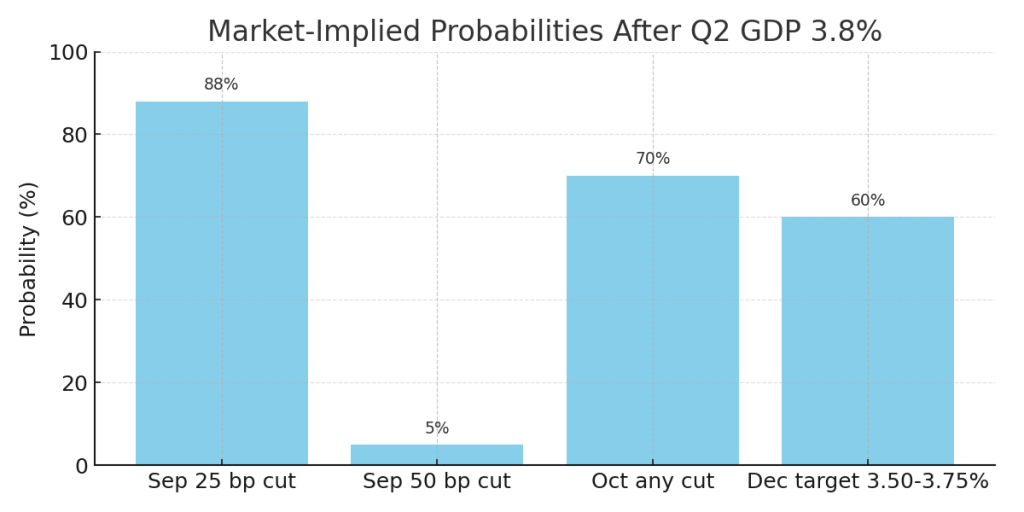
  • Markets may now price fewer total rate cuts in 2025, especially in October and December.

2️⃣ Stock Market Implications

  • Cyclicals benefit: Industrials, materials, consumer discretionary, tech hardware/semiconductors may rally.
  • Defensives lag: Utilities, REITs, consumer staples underperform in a strong-growth environment.
  • Rate-sensitive tech: High-multiple growth stocks may face short-term pressure if the market thinks Fed cuts will be smaller or slower.

3️⃣ Bond Market Implications

  • Treasury yields rise, particularly in the short- and intermediate-term, as expectations for Fed cuts decline.
  • Bond prices fall as yields climb.

4️⃣ Currency & Commodities

  • USD strengthens: Strong growth attracts global investment flows.
  • Gold declines: Higher yields reduce safe-haven appeal.
  • Commodities/oil rise: Stronger growth signals higher demand.

5️⃣ Market Summary Table

AssetLikely Reaction
Stocks (cyclical)
Stocks (defensive)
Bonds↓ (yields ↑)
USD
Gold
Commodities

Key takeaway: Q2’s 3.8% GDP signals the U.S. economy is resilient, lowering the probability of aggressive Fed rate cuts. Cyclical sectors and commodities are poised to benefit, while bonds, gold, and defensive equities may see headwinds.

Chance of a Recession this Year

Short answer: Markets & big forecasters put the U.S. recession probability for the rest of 2025 roughly in the 30–40% range today, but estimates vary from the low-teens up to the 50–60% area depending on the model and timing of the call.

Here’s a quick, sourced read on why that range is so wide and what could push it higher or lower.

Why forecasters disagree

  • Different models & inputs. Some groups (Goldman, JPMorgan, IMF, private forecasters) weight trade/tariffs, payroll revisions, inflation, and financial-market signals differently — producing Goldman ≈30%, JPMorgan ≈40% (recent update), and IMF/others ~40% estimates. (fi-desk.com)
  • Timing matters. A model that asks “recession in next 6 months?” gives different odds than “recession this calendar year.”
  • Fast-changing data. Big downward payroll revisions, sticky core inflation prints, or new tariff moves rapidly change the odds (markets reprice in days).

Key drivers that raise recession odds

  • Major, persistent labor weakness (continued big payroll downgrades or rising unemployment).
  • A sharp earnings and hiring pullback that feeds into consumer spending declines.
  • Policy confusion — sticky inflation plus weak growth could force the Fed into a painful tradeoff (no cut = growth hit; cut = inflation re-acceleration).
  • Escalating trade or geopolitical shocks that damage exports/supply chains. (Federal Reserve)

Key drivers that lower odds

  • Inflation falling more clearly (PPI/CPI/PCE easing), giving the Fed room for orderly cuts and supporting demand.
  • Resilient corporate capex, especially AI-related investment, keeping jobs and earnings supported.
  • Trade de-escalation or fiscal support that offsets private weakness. (IMF)

Market implications if odds rise vs fall

  • Odds rise (recession more likely): bonds rally (yields ↓), gold and safe havens ↑, cyclical equities and financials underperform, tech/quality may initially rally on rate cuts but could fall if earnings deteriorate.
  • Odds fall (soft landing more likely): equities rally broadly (tech + cyclicals), yield curve may steepen moderately, USD softens.

1) Market-implied probabilities (what markets are pricing now)

  • September 2025 meeting (next FOMC)
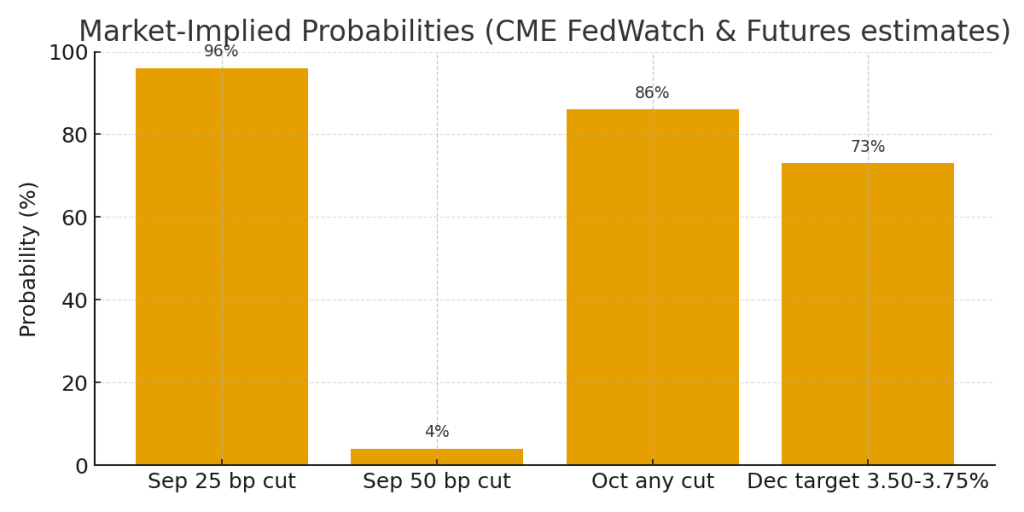
    • ~95–96% probability of a 25 bps cut (i.e., markets expect a quarter-point cut). (CME Group)
  • October 2025 meeting
    • Odds for another cut in October have jumped — Reuters notes futures lifted chances for easing in October to ~86% after the September cut. (Reuters)
  • Total easing priced for 2025 (by year-end)
    • Markets are pricing roughly ~60–80 bps of cuts in total for 2025 (i.e., 2–3 quarter-point cuts including the one in September). Many futures-based trackers and analysts converge around ~70 bps of cuts priced in for the remainder of the year. (Reuters)
  • Probability of a “jumbo” 50 bps cut in September
    • Still low but non-zero — generally ~5–10% depending on the source. Statista / CME snapshots and news pieces put this in single digits. (Statista)
  • Recession probability context
    • Major banks’ published recession probabilities are clustered in the ~30–40% range for a U.S. recession within the next 12 months, though models vary. (Markets and some houses earlier priced higher and then trimmed odds as data evolved). (JPMorgan Chase)

2) Two scenario models and the expected market reactions

I’ll show each scenario, how likely markets currently think it is, the immediate asset reactions, sector winners/losers, and suggested portfolio tilts and risk controls.


Scenario A — Soft Landing (base / market-priced)

Probability (market-implied): ~50–65% (markets are leaning toward this via FedWatch + futures pricing). (CME Group)

Description: Fed cuts ~25 bps in Sept and another 25 bps later in 2025; inflation drifts lower, jobs stabilize (no large spike in unemployment), growth slows but remains positive.

Immediate asset moves (days → weeks):

  • Stocks: Mild-to-moderate rally; tech, growth, REITs and small caps outperformance.
  • Bonds: Short-term yields fall (2-yr down), long yields drift down less → yield curve steepens modestly.
  • Dollar: Modestly weaker.
  • Gold: Rises modestly.
  • Commodities/Oil: Mixed; oil steadies on demand hopes.

Sector winners / losers

  • Winners: Tech/AI/semi equipment, housing/REITs, consumer discretionary, small caps.
  • Losers/underperformers: Short-duration financials (some margin compression), defensives (utilities/staples) may lag.

Portfolio tilt (example, tactical 3-month):

  • Equities: +5–10% overweight growth/tech & select cyclical exposure.
  • Bonds: +5–10% overweight high-quality duration (2–7 year Treasuries).
  • Cash: Trim — 5% buffer to buy dips.
  • Gold: +2–4% as insurance.

Risk management:

  • Keep stops or hedges on concentrated tech positions (market is sensitive to guidance).
  • Ladder Treasuries (reduce reinvestment shock).

Scenario B — Hard Landing / Recession Risk

Probability (market-implied tail risk): ~20–35% (markets price a nontrivial chance; some forecasters place odds higher ~30–40%). (JPMorgan Chase)

Description: Despite cuts (25–50 bps total), payroll revisions/ongoing weakness push unemployment higher, corporate earnings degrade. Cuts are seen as reactive, not preventive → growth contracts.

Immediate asset moves:

  • Stocks: Short-term rally on initial dovish surprise may give way to a broader equity selloff as earnings forecasts get cut. Cyclicals and small caps hit hardest.
  • Bonds: Strong rally (yields fall across curve), 2-yr falls sharply as Fed cuts are front-loaded.
  • Dollar: Initially weak on cuts, but can become volatile — in a global risk-off the USD can strengthen as a safe haven.
  • Gold: Strong safe-haven demand → substantial gains.
  • Commodities/Oil: Fall on demand worries.

Sector winners / losers

  • Winners: High-quality long duration bonds, gold, consumer staples/defensive healthcare, select utilities.
  • Losers: Banks (credit cycle & NIM pressure), capital goods, industrial cyclical names, energy (lower demand).

Portfolio tilt (defensive 3-month):

  • Equities: Reduce exposure; shift toward quality dividend payers + defensives. (e.g., 30–40% equity allocation instead of 60% baseline).
  • Bonds: Increase allocation to high-quality Treasuries and investment-grade corporates; overweight duration (2–10y).
  • Cash / Liquidity: Step up to 10–15% for optionality.
  • Gold: Increase to 5–8% as hedge.
  • Alternative hedges: Consider small allocation to tail-risk hedges (protective puts, managed futures).

Risk management:

  • Trim levered / highly cyclical exposures quickly on signs of earnings downgrades.
  • Monitor credit spreads (if spreads widen, reduce credit risk).

Practical what to watch next (data & market signals that should change odds)

  • Weekly jobless claims & next payrolls — if claims rise and payrolls remain weak, Hard Landing odds increase.
  • Core CPI / PCE prints — sticky inflation reduces the Fed’s ability to cut more, lowering Soft Landing odds.
  • Fed communications & dots — if dot plot keeps signaling cuts, markets price them in; hawkish tone can reverse expectations fast. (Reuters)
  • Credit spreads & high-yield performance — early warning of stress; widening spreads point to higher recession risk.
  • Equity breadth and earnings revisions — broad downgrades imply growth risk.

Quick action checklist (if you manage money)

  1. Re-check position size in tech/growth — they’re most sensitive to a Fed policy surprise.
  2. Ladder into longer-duration Treasuries or a short-duration bond ladder if you want yield + safety.
  3. Keep cash buffer (5–15%) to buy quality on weakness.
  4. Use stop loss or protective options for concentrated bets — a small premium buys big asymmetric protection.
  5. Track the five key data points weekly (jobs, CPI/PCE, claims, credit spreads, Fed speak).

Sources and evidence (most important market-facing references)

  • CME FedWatch (market-implied probabilities for Fed moves). (CME Group)
  • Reuters reporting on futures boosting the odds of further easing after the Sept cut. (Reuters)
  • CBS / Statista snapshots summarizing cut probabilities (95–96% for Sept 25 bps). (CBS News)
  • J.P. Morgan analysis on recession probability shifts. (JPMorgan Chase)
  • CME rates recap showing elevated futures positioning and activity. (CME Group)

Will the Feds cut rates again this year?

Based on the latest information, it’s quite likely that the Fed will cut rates at least a couple more times this year. Here’s a breakdown of the evidence, the Fed’s stance, and what could make cuts more or less likely:


✅ Why More Cuts Are Likely

  1. Recent Cut + Dot Plot Projections
    After cutting the fed funds rate by 25 basis points (bps), Fed officials projected two more quarter-point cuts for the remainder of 2025. (Reuters)
  2. Economic Indicators Softening
    The labor market is weakening (job growth slowing, revisions showing far fewer jobs added), which shifts the Fed’s risk assessment toward downside risks for employment. (Reuters)
    Inflation remains above target but hasn’t been accelerating aggressively, giving the Fed some leeway. (Federal Reserve)
  3. Market Expectations
    Futures markets and major banks are leaning toward more cuts. For example, JPMorgan sees a strong chance of another 25-bps cut, and some analysts believe there could be three or more cuts into early 2026. (Business Insider)

⚠️ What Could Prevent or Limit Further Cuts

  • If inflation (especially core PCE or CPI) remains stubbornly high or turns up again, that could make the Fed more cautious.
  • Stronger-than-expected economic data (GDP growth, consumer spending, manufacturing) might reduce pressure to ease.
  • Global risks or shocks (e.g. energy price spikes, geopolitics, trade policy issues) that push up inflation or disrupt supply chains.
  • Concerns about losing credibility in inflation control could push the Fed to move slower.

📊 What to Expect

Here’s a rough timeline and what markets are pricing in:

  • Two more 25-bps cuts during the rest of 2025, likely at upcoming FOMC meetings. (Reuters)
  • Possible one more cut in early 2026, depending on how inflation and labor market data evolve. (Federal Reserve)

What Does Latest Rate Cut Mean?

The Feds just cut interest rates by 25 basis point (bp). Here’s what that signals and how it ripples out:


🏦 Economic Meaning

  • Cheaper Credit: Mortgages, auto loans, and business loans gradually become cheaper.
  • Stimulus: Encourages spending and investment, aiming to support slowing growth.
  • Confidence Signal: A 25 bp cut is a measured step — not panic, but a sign the Fed sees the economy softening.
  • Inflation Watch: The Fed is easing, but carefully — they’re not sure inflation is fully under control.

📊 Market Impact

  • Stocks: Generally bullish — especially for growth/tech and real estate. But if investors think the cut means a looming recession, gains may fade.
  • Bonds: Short-term yields fall most, boosting bond prices. Long-term yields may fall too if growth fears rise.
  • U.S. Dollar: Slightly weaker — lower yields make USD less attractive.
  • Gold/Commodities: Gold often rises (lower real yields), oil/metals can benefit if growth looks supported.
  • Banks: Mixed — loan demand improves, but margins may narrow.

⚖️ Context

  • If inflation is falling, this cut looks supportive → “soft landing” optimism.
  • If inflation is still sticky, the cut risks fueling more price pressures → markets may get nervous.

Bottom line:
A 25 bp cut is the Fed’s way of saying: “We see the economy slowing, but we’re not in crisis mode.” It’s a supportive move, not a rescue move.


What to Expect from a Potential Fed Rate Cut this week

When the Fed cuts rates, the market reacts differently depending on why the cut is happening (growth slowdown vs. financial stress vs. inflation under control). But here’s the typical playbook:


📉 Bonds

  • Short-term Treasuries (2Y, 5Y): Yields drop the most — directly tied to Fed policy.
  • Long-term Treasuries (10Y+): Can fall too, but if markets worry about inflation, the drop is smaller.
  • Net: Bond prices rise, especially in the short end.

📈 Stocks

  • Growth / Tech: Big winners → lower discount rates boost valuations.
  • Small Caps: Benefit from cheaper borrowing costs.
  • Financials: Mixed → lower rates can compress bank margins, but more loan demand helps.
  • Defensives (utilities, staples): Often lag in a rate-cut rally.
  • Net: Stocks rally short term, but if cuts signal recession fears, gains can fade.

💵 U.S. Dollar

  • Rate cuts usually weaken the dollar (lower yields make USD less attractive).
  • But if other economies are weaker, the dollar can still hold up.

🪙 Gold & Commodities

  • Gold: Bullish — lower real yields + weaker USD.
  • Oil / Industrial metals: Could rise if cuts are seen as boosting demand.

⚖️ Context Matters

  • Soft Landing Cut (inflation down, economy stable): Markets cheer → risk assets surge.
  • Recession Cut (jobs + growth collapse): Initial rally, then volatility as earnings outlook worsens.

Bottom line:

  • Near-term: Stocks and bonds likely rally, USD softens, gold rises.
  • Medium-term: Market reaction depends on whether the cut is a “confidence boost” (bullish) or a “panic cut” (bearish).

Here’s a scenario matrix for the upcoming Fed decision, given the backdrop of weak jobs + sticky inflation:


📊 Fed Rate Cut Scenarios & Market Reactions


1) 25 bps Cut (Base Case / Cautious Easing)

  • Stocks → Mild rally. Growth/tech up, but not euphoric since it looks cautious.
  • Bonds → Short-term yields drop modestly, curve stays inverted.
  • USD → Slightly weaker, but not a major selloff.
  • Gold → Edges higher (real yields lower).
  • Message → Fed balancing act → “We’re watching inflation, but also supporting jobs.”
    ✅ Market interprets as a measured soft-landing approach.

2) 50 bps Cut (Dovish Surprise)

  • Stocks → Initial surge (risk-on). Tech + small caps lead.
  • Bonds → Big rally in short-term Treasuries, yields drop fast.
  • USD → Weaker — carry trade flows out of USD.
  • Gold & Commodities → Spike higher (gold: real yields collapse, oil/commodities: demand optimism).
  • Message → Fed more worried about growth than inflation.
    ⚠️ Market may later question: “Do they know something worse about the economy?”

3) No Cut (Hawkish Hold)

  • Stocks → Selloff, especially growth/tech. Cyclicals under pressure.
  • Bonds → Short-end yields jump → curve flattens/inverts more.
  • USD → Strengthens → global risk-off.
  • Gold → May hold up (as risk hedge), but no strong rally.
  • Message → Fed prioritizing inflation fight over jobs.
    ⚠️ Market sees this as policy risk → tightening into slowdown.

🔑 Big Picture

  • A 25 bps cut is most likely and would calm markets.
  • A 50 bps cut sparks a short-term rally but raises recession fears later.
  • No cut shocks markets → likely worst short-term outcome for equities.

Great — here’s a sector-by-sector breakdown for the 3 Fed rate cut scenarios:


📊 Sector Impact by Fed Cut Scenario


1) 25 bps Cut (Measured Easing – Base Case)

  • Tech / Growth: ✅ Positive, steady rally as discount rates ease.
  • Financials (Banks): ⚖️ Mixed — loan demand improves, but margins narrow a bit.
  • Energy / Materials: ➕ Mildly positive if demand outlook stabilizes.
  • Real Estate (REITs, housing): ✅ Relief — borrowing costs dip slightly.
  • Consumer Discretionary: ➕ Positive — cheaper credit supports spending.
  • Utilities / Staples: ⚠️ Laggards — less defensive demand in a modest risk-on environment.

2) 50 bps Cut (Dovish Surprise – Aggressive Easing)

  • Tech / Growth: 🚀 Big winners, as valuations re-rate higher.
  • Financials (Banks): ❌ Negative — sharp margin compression, weak outlook for profitability.
  • Energy / Materials: ✅ Strong upside — demand optimism and weaker USD boost commodities.
  • Real Estate: 🚀 Big rally — mortgage rates drop more aggressively.
  • Consumer Discretionary / Small Caps: 🚀 Strong — cheap credit + weaker USD helps exporters.
  • Utilities / Staples: ⚠️ Underperform — money flows into growth sectors instead.

3) No Cut (Hawkish Hold – Surprise)

  • Tech / Growth: ❌ Hit hard — higher discount rates weigh on valuations.
  • Financials: ✅ Slightly positive — higher rates protect bank margins.
  • Energy / Materials: ❌ Weak — growth slowdown fears outweigh any inflation hedge play.
  • Real Estate: ❌ Selloff — mortgage rates remain high, housing demand weakens.
  • Consumer Discretionary: ❌ Negative — consumers squeezed by higher borrowing costs.
  • Utilities / Staples: ✅ Defensive inflows — investors rotate to safe havens.

🔑 Takeaway

  • 25 bps = “steady glide path” → broad but modest rally.
  • 50 bps = “all-in easing” → growth sectors rip, but banks suffer.
  • No cut = “hawkish surprise” → broad equity selloff, defensives + banks hold up best.

Potential Market Reaction to Recent BLS Jobs Report

BLS made a 911,000 downward revision to U.S. payrolls. It is one of the largest in recent memory. Here’s how that shock ripples across markets:


📉 What the Revision Means

  • Labor market not as strong as thought → hiring overstated, economy weaker.
  • Signals slowdown in consumer spending, housing demand, and business investment.
  • Fed implications → gives the Fed cover to cut rates more aggressively.

📊 Market Impact Breakdown

Stocks

  • Rate-sensitive sectors (tech, housing, REITs): Likely to pop higher on lower-rate expectations.
  • Cyclicals (industrials, consumer discretionary, energy): Could struggle — weaker demand outlook.
  • Financials: Negative — banks face weaker loan demand + margin pressure if cuts accelerate.
  • Overall: Short-term rally, but longer-term risk of recession-driven correction.

Bonds

  • Treasuries rally hard — especially 2Y and 5Y.
  • Yield curve steepens → short-term yields fall more than long-term as markets price in cuts.
  • Fed funds futures may start pricing a 50 bps cut sooner.

U.S. Dollar

  • Likely weaker — Fed seen as easing faster.
  • But if recession fears rise, safe-haven flows could bring volatility.

Gold & Commodities

  • Gold 🚀 bullish — weaker dollar + lower yields + safe-haven demand.
  • Oil & industrial metals: Bearish — softer jobs = weaker demand outlook.

⚖️ Big Picture

  • The revision changes the narrative:
    • Before: “Labor market resilient, Fed cautious.”
    • Now: “Labor market weaker, Fed must cut.”
  • Markets may cheer at first (dovish pivot) but risk shifting to “hard landing” fears if hiring proves much weaker across sectors.

Bottom line:

  • Bonds and gold = clear winners.
  • Tech & housing = near-term winners.
  • Cyclicals, banks, energy = under pressure.
  • Raises odds of a larger September rate cut (50 bps) and puts recession risk front and center.

Got it 👍 — here’s a 3-month market outlook (Sept → Dec 2025) now that the BLS has revised payrolls down by 911,000 jobs.


📊 3-Month Market Outlook After Jobs Revision


🏦 Stocks

  • Near Term (Sept–Oct):
    • Tech, housing, REITs rally on lower-rate expectations.
    • Financials & cyclicals underperform (weaker loan growth, demand concerns).
    • S&P 500 may bounce short term, but gains could fade if earnings guidance weakens.
  • By Year-End:
    • If Fed cuts 50 bps and inflation stays tame → rally resumes.
    • If hiring keeps collapsing → hard landing correction (10%+ drawdown risk).

📈 Bonds

  • Short-term (2Y): Yields drop sharply (pricing multiple cuts).
  • Long-term (10Y+): Yields drift lower but less dramatically → yield curve steepens.
  • By Year-End: Treasuries remain bid as investors hedge recession; safest asset class near term.

💵 U.S. Dollar

  • Near Term: Weakens as markets bet on faster Fed easing.
  • Later (Nov–Dec): If recession fears deepen globally, dollar could rebound on safe-haven demand.
  • Outlook = volatile, but bias is downside vs. major currencies (EUR, JPY, CNY) in Q4.

🪙 Gold & Commodities

  • Gold: Big winner → benefits from lower yields + weaker USD + safe-haven flows. Could test all-time highs this fall.
  • Oil & industrial metals: Bearish bias — softer labor market = weaker demand outlook. Watch for OPEC+ cuts as a stabilizer.

⚖️ Scenario Paths

1. Soft Landing (Fed cuts 25–50 bps, growth stabilizes)

  • Stocks: Recover into year-end (tech, housing lead).
  • Bonds: Stay supported, curve steepens.
  • Dollar: Weak.
  • Gold: High, but stabilizes.

2. Hard Landing (Fed cuts, but jobs keep sliding)

  • Stocks: Drop 10–15% as earnings estimates are cut.
  • Bonds: Strong rally (2Y < 3%).
  • Dollar: Whipsaws — weak on cuts, strong if crisis fear rises.
  • Gold: 🚀 Best performer (safe-haven + falling yields).

Bottom Line:

  • Next 1–2 months: Expect a risk rally (tech, housing, gold, bonds up).
  • Late Q4: Depends on jobs trend → if hiring keeps slowing, recession trades dominate (bonds & gold keep winning, stocks pull back).

Market Effects of a Potential Fed Rate Cut

A Fed rate cut is one of the most powerful policy levers in markets. Here’s a breakdown of how it tends to affect different parts of the financial system — and why September’s potential cut is being watched so closely:


📊 1. Stock Market

  • Bullish for equities (in theory):
    • Lower borrowing costs → boosts corporate profits.
    • Higher valuations as future earnings are discounted at lower rates.
    • Rate-sensitive sectors (tech, housing, utilities) usually rally.
  • Caution:
    • If the Fed is cutting because the economy is weakening, stocks may struggle (a “bad news = bad news” scenario).

💵 2. Bond Market

  • Treasury bonds: Prices rise, yields fall as investors anticipate easier policy.
  • Corporate bonds: Borrowing costs decline → better conditions for refinancing debt.
  • Yield curve: Cuts often steepen the curve (short-term yields fall faster than long-term).

💲 3. U.S. Dollar (Forex)

  • Lower rates make U.S. assets less attractive → dollar typically weakens.
  • A weaker dollar benefits exporters and multinational companies.

🪙 4. Gold & Commodities

  • Lower yields reduce the opportunity cost of holding gold → bullish for gold.
  • Weaker dollar also lifts commodities priced in dollars (oil, metals, agriculture).

🏠 5. Housing & Real Economy

  • Mortgage rates fall → more affordability for buyers, possible rebound in housing demand.
  • Businesses face lower financing costs → more capital spending.
  • Consumers pay less on credit cards, auto loans → improved spending power.

⚖️ Market Context Right Now (Sept 2025)

  • Why the Fed might cut: Weak jobs report (22k jobs added, rising unemployment), slowing housing market, cooling inflation.
  • What’s priced in: Markets expect at least 25 bps, some betting on 50 bps.
  • Risk: If cuts are seen as a response to serious economic weakness, the initial rally could fade as recession fears rise.

Bottom line:

  • A Fed cut usually boosts stocks, bonds, and gold while weakening the dollar.
  • The market’s reaction depends on the narrative:
    • “Soft landing” → bullish (rate cuts extend growth).
    • “Hard landing” → bearish (cuts can’t stop a slowdown).

📊 Fed Rate Cut Scenarios & Market Impact

Fed Decision (Sept 2025)StocksBonds (Yields)U.S. DollarGold & CommoditiesNarrative / Market Mood
25 bps cut (base case)📈 Mild rally, especially in tech, housing, utilities. Banks mixed.Yields drift lower (esp. 2-yr). Curve steepens slightly.Weakens modestly.Gold up modestly, oil supported by weaker dollar.“Measured easing” → soft landing hopes.
50 bps cut (dovish surprise)🚀 Strong rally in growth stocks & housing. Cyclicals mixed (fear of slowdown).Yields plunge, bonds surge.Weakens sharply.Gold spikes toward new highs; commodities broadly higher.“Emergency cut” → could cheer markets short-term but raise recession concerns.
No cut (hawkish surprise)📉 Stocks drop, esp. rate-sensitive tech & REITs.Yields jump higher; bond selloff.Strengthens sharply.Gold falls; oil down on stronger dollar.“Fed behind the curve” → risk-off, higher volatility.

⚖️ How to Read This

  • 25 bps cut: Easiest for markets to digest — dovish enough to support assets, not panicky.
  • 50 bps cut: Big near-term boost for risk assets (stocks, gold), but raises questions: Is the economy worse than expected?
  • No cut: Would shock markets — likely selloff across stocks and bonds, stronger dollar, and higher volatility.

Bottom line:

  • If the Fed cuts 25 bps, markets rally steadily.
  • If it cuts 50 bps, markets pop big but may wobble as traders debate “hard landing” risk.
  • If no cut, expect a sharp correction.

Here’s the sector-by-sector breakdown for each Fed rate cut scenario at the September meeting:


🏦 Sector Playbook: Fed Cut Scenarios

Fed DecisionTech (AI, semis, cloud)Financials (banks, insurers)Housing / REITsEnergy / CommoditiesDefensives (healthcare, utilities, staples)
25 bps cut (base case)🚀 Boosted (lower discount rates, cheaper capital).Mixed — loan margins shrink, but stable outlook.📈 Positive — lower mortgage rates spur demand.Mildly positive from weaker dollar.Stable, modest gains.
50 bps cut (dovish surprise)🚀🚀 Big rally — growth stocks thrive.😬 Negative — sharp margin compression, signals weak economy.🚀 Strong rebound — mortgages cheaper, REITs soar.Commodities rally (weak USD), but recession fears cap oil.📈 Strong bid as investors hedge slowdown risk.
No cut (hawkish surprise)📉 Sharp selloff — most sensitive to higher rates.📈 Positive for banks (wider margins), insurers benefit.📉 Hit hard — housing demand weakens.Oil & commodities fall on strong dollar.📈 Attract flows as safe havens.

⚖️ Key Insights

  • Tech & Housing = biggest winners if the Fed cuts.
  • Banks: Do best if no cut (higher margins), but struggle under larger cuts.
  • Energy: Moves more with global demand; a weaker dollar supports oil & metals, but slowdown risk offsets.
  • Defensives: Attract flows in both 50 bps cut (recession fears) and no cut (risk-off) scenarios.

Bottom Line:

  • 25 bps cut → Balanced bullishness. Tech + housing lead, market stable.
  • 50 bps cut → Explosive rally in growth/housing, but signals possible recession → defensives also rise.
  • No cut → Tech & housing slump, banks & defensives outperform.

📊 Fed Rate Cut Scenarios: Full Portfolio Impact

Fed DecisionStocksBonds – Short-Term (2Y)Bonds – Long-Term (10Y+)U.S. DollarGold & CommoditiesMarket Mood
25 bps cut (base case)📈 Mild rally (tech + housing strongest).📉 Yields fall modestly → prices rise.📉 Yields edge lower → curve steepens slightly.Weaker, but not sharply.Gold + commodities tick higher.“Soft landing still alive.”
50 bps cut (dovish surprise)🚀 Growth stocks + REITs surge; banks pressured.📉📉 Yields plunge — bonds rip higher.📉 Yields drop, but less than 2Y → strong steepening.Sharp weakening.Gold spikes 🚀; oil + metals rise.“Emergency easing” → short-term euphoria, recession worries linger.
No cut (hawkish surprise)📉 Selloff — tech + housing hit hardest.📈 Yields jump — bonds sell off.📈 Yields rise, but less than 2Y → curve flattens.Dollar strengthens strongly.Gold + commodities drop.“Fed behind the curve” → risk-off, volatility spike.

⚖️ Bond Market Mechanics

  • Short-term bonds (2Y) move most with Fed expectations. Cuts → strong rally; no cut → steep losses.
  • Long-term bonds (10Y+) move more with growth/inflation outlook. Cuts steepen curve (2Y down faster), while no cut flattens curve.
  • Steepening curve → suggests policy easing; flattening → markets fear growth slowdown or tight policy.

Big Picture Takeaway

  • 25 bps cut: Best-case balance → steady stock rally, moderate bond gains, stable dollar weakness.
  • 50 bps cut: Short-term party for stocks, bonds, and gold, but could spark “Why so aggressive?” recession fears.
  • No cut: Risk-off across equities/commodities, bonds and dollar diverge (bonds down, USD up).

How will the recent job report affect the markets

Here’s how the August U.S. jobs report shook up the markets and what it means going forward:


Key Takeaways from the Job Report

Weakest Job Growth in Years

  • In August, the U.S. added just 22,000 jobs, a stark miss compared to the ~75,000 forecast and a sharp slowdown from earlier months.
  • June’s data was revised into a 13,000 job loss, marking the first decline since 2020.
  • The unemployment rate rose to 4.3%, the highest since 2021.
  • Manufacturing continues to struggle, shedding jobs for four months in a row.

Market Reactions & Investor Sentiment

Equities

  • Initial uplift: Stock futures rose as weaker job data reinforced expectations for a Fed rate cut.
  • Volatility kicked in: Though equities briefly neared record highs, markets pulled back as the weakness raised broader slowdown concerns.

Bonds & Yields

  • Yields plunged:
    • 2-year Treasury yield dropped to around 3.47%.
    • 10-year yield fell to roughly 4.07%, nearing April lows.
  • Investors rushed into Treasuries, signaling strong demand for safer assets.

U.S. Dollar & Gold

  • Dollar weakened, reflecting lower interest rate expectations.
  • Gold soared, hitting new highs near $3,600/oz, driven by rate-cut expectations and safe-haven flows.

Fed Rate Cut Expectations

  • Markets now strongly expect a September rate cut, with many pricing in a 25-basis-point cut and some even betting on a 50-basis-point move.

Summary Table

Asset / IndicatorMarket Reaction / Outlook
StocksBrief rally then retraction; mixed sentiment persists.
Bonds (Yields)Yields tumbled as investors anticipated Fed easing.
U.S. DollarWeakened amid outlook for softer monetary policy.
GoldSurged to new highs on safe-haven demand and rate cut bets.
Fed PolicyRate cut in September now almost certain; some expecting larger movement.

Bottom Line

The soft August jobs report has reinforced the narrative that the labor market is cooling—which the Fed is unlikely to ignore. While markets were initially buoyed by rate-cut prospects, underlying economic concerns remain real. The bond market and gold responded strongly, while equity markets remain sensitive to incoming data and Fed signals.