How Iran’s Attacks in the Strait of Hormuz and Record Oil Reserve Releases Are Shaking Global Markets

The past week has delivered some of the most dramatic swings in energy and financial markets in years. As Iran ramps up attacks on commercial vessels in the Strait of Hormuz—a waterway that normally handles about 20% of global oil shipments—oil markets have rocketed, some producers have cut output, and governments have responded with unprecedented intervention.


🛢️ Oil Markets: Prices Up, Volatility Up

Despite a historic intervention by the International Energy Agency (IEA) to release 400 million barrels from global strategic reserves—the largest such release in history—oil prices have remained elevated and volatile. Crude benchmarks like Brent have traded above $90–$100 per barrel as supply fears persist.

This demonstrates two key points:

  1. Reserve releases temper extreme price spikes, but they cannot fully offset sudden disruptions.
  2. Markets are pricing in a significant risk premium because the Strait of Hormuz remains threatened and regional energy infrastructure is under attack.

⚓ The Strait of Hormuz: A Choke Point With Global Reach

The Strait of Hormuz is a critical artery for global oil. Any disruption affects not only Iranian exports but also supplies from Saudi Arabia, Iraq, Kuwait, and the UAE. Even temporary interruptions trigger rapid price swings as traders hedge for worst-case scenarios.


📉 Broader Market Impact

  1. Stock markets have wobbled — global equity indexes dipped as oil prices surged and inflation fears grew. Energy costs affect transportation, manufacturing, airlines, and logistics.
  2. Supply chains beyond energy are strained — freight disruptions and rising shipping costs ripple through global commodity flows.
  3. Safe-haven assets are in demand — investors rotate into bonds, gold, and other low-risk assets during periods of uncertainty.

💹 Inflationary Pressure Forecast

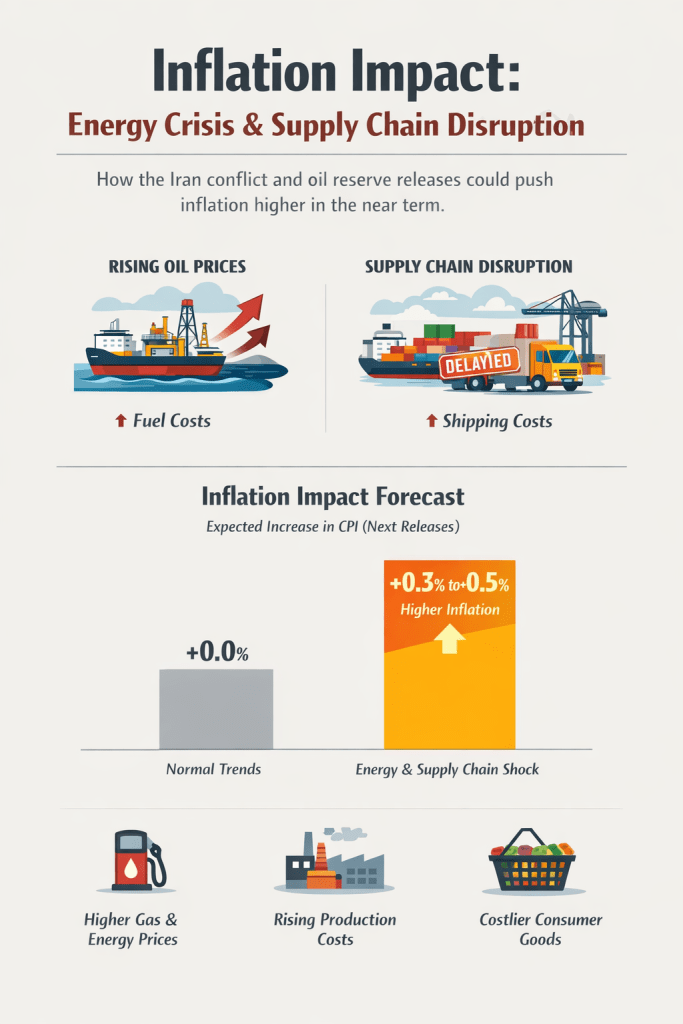
The combination of elevated oil prices and disrupted shipping routes is expected to push inflation higher in the near term. Key points:

  • Transportation costs rise as shipping becomes riskier and fuel prices climb.
  • Goods production costs increase because petroleum-based inputs for manufacturing and chemicals become more expensive.
  • Consumer prices for energy and essential goods are likely to increase in the coming months, adding pressure on headline inflation.

Analysts forecast that inflation readings could be 0.3–0.5% higher than baseline expectations in the next CPI releases, primarily driven by energy and transportation costs. Central banks may respond cautiously, weighing both the temporary nature of the shock and the risk of broader economic slowing.


🧠 What the IEA Release Really Means

The coordinated release of 400 million barrels is extraordinary:

  • Provides near-term supply relief
  • Signals global policymakers are taking the energy shock seriously
  • Demonstrates international cooperation in a global energy crisis

However, markets see it as a stabilizing buffer, not a permanent solution. If attacks in the Strait of Hormuz continue, oil supply shocks and inflationary pressures are likely to persist.


📊 In Summary

With Iran attacking ships in the Strait of Hormuz and a record oil reserve release underway, markets are reacting on multiple fronts:

  • Oil prices remain elevated and volatile.
  • Equity markets are cautious due to inflation and growth concerns.
  • Supply chain costs beyond energy are climbing.
  • Inflationary pressure is expected to rise in the near term.

Even with strategic reserve releases, the uncertainty surrounding shipping lanes and regional energy security will keep markets headline-driven in the coming weeks.

Iran War: Impact on Oil Production, Prices, and the Global Supply Chain

The ongoing conflict involving Iran has quickly become one of the most significant shocks to global energy markets in recent years. Because the Middle East sits at the center of global oil production and transportation, disruptions in the region can ripple through the entire energy ecosystem—from crude production to transportation networks and global supply chains.

Impact on Oil Production

Iran is a meaningful oil producer. Under normal conditions, the country produces roughly 3.2 million barrels of oil per day, exporting about 1.4 million barrels daily to global markets.

However, the broader risk extends far beyond Iran’s own output. Military strikes, infrastructure damage, and regional instability have the potential to affect oil facilities across multiple Gulf producers and disrupt logistics throughout the region. In total, disruptions in the region could threaten up to one-fifth of global oil supply, making the conflict a major global energy event rather than a localized issue.

Oil production can also fall indirectly during conflicts because:

  • Workers evacuate or halt operations
  • Facilities are damaged or temporarily shut down
  • Export terminals become inaccessible
  • Tanker shipping becomes unsafe

Even temporary shutdowns can tighten global supply significantly.

Disruption of Shipping Routes

One of the biggest risks comes from the Strait of Hormuz, a narrow shipping channel between Iran and Oman that handles roughly 20% of the world’s oil shipments.

During periods of conflict, shipping activity in the strait often slows as tanker operators avoid the area due to security risks. When shipping routes become unstable:

  • Oil exports slow or stop
  • Tankers remain anchored offshore
  • Storage facilities fill up
  • Global energy supply chains tighten

Because so much oil passes through this chokepoint, even the threat of disruption can cause markets to react immediately.

Impact on Oil Prices

Energy markets typically see sharp volatility during geopolitical conflicts in the Middle East. Prices often rise quickly as traders price in potential supply shortages and geopolitical risk.

Several factors push prices higher during conflicts:

  • Reduced production capacity
  • Shipping disruptions
  • Increased insurance and transport costs
  • A geopolitical “risk premium” added by traders

Even if physical supply remains mostly intact, markets often bid prices higher simply due to uncertainty.

Effects on the Global Supply Chain

Higher oil prices and disrupted shipping routes can have far-reaching consequences beyond the energy sector. Oil is a fundamental input into transportation, manufacturing, and logistics worldwide.

When oil prices rise or supply becomes unstable, supply chains may experience:

Higher transportation costs
Trucking, rail, shipping, and air freight all rely heavily on fuel. Rising fuel prices increase the cost of moving goods globally.

Manufacturing cost pressures
Many industrial materials and chemicals depend on petroleum-based inputs, which can increase production costs.

Shipping delays and bottlenecks
If tanker traffic slows through key routes like the Strait of Hormuz, it can delay deliveries and tighten global inventories.

Food and consumer price pressure
Higher transportation and fertilizer costs can eventually flow through to food and consumer goods prices.

Broader Economic Implications

Energy price shocks have historically rippled through the broader economy. Rising oil prices can increase business operating costs, reduce consumer purchasing power, and contribute to inflation.

For consumers, the most visible effects are often:

  • Higher gasoline prices
  • More expensive shipping and transportation
  • Rising costs for everyday goods

The Bottom Line

The Iran conflict is impacting the global energy system through multiple channels at once: potential disruptions to production, threats to key shipping routes, and heightened geopolitical risk.

Together, these factors are increasing volatility in energy markets and putting pressure on global supply chains. Even if the conflict stabilizes in the near term, the ripple effects could continue influencing energy markets and global trade for months.