After four months of conflict that rattled energy markets, shuttered the world’s most critical oil chokepoint, and sent inflation surging, a 14-point memorandum of understanding (MOU) is officially on paper. Now comes the harder question: what does it actually change?

How we got here
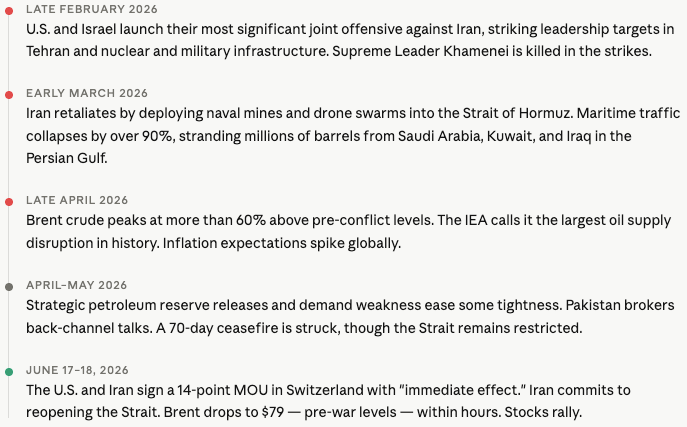
What changed: we now have the actual text
For days after President Trump announced the deal at the G7 in Evian, markets were trading on optimism without details. That changed Wednesday, when senior U.S. officials read the full 14-point text to reporters. Iran’s government subsequently published it on X, with both versions matching. Here’s what the MOU actually says — and what it means for your portfolio.
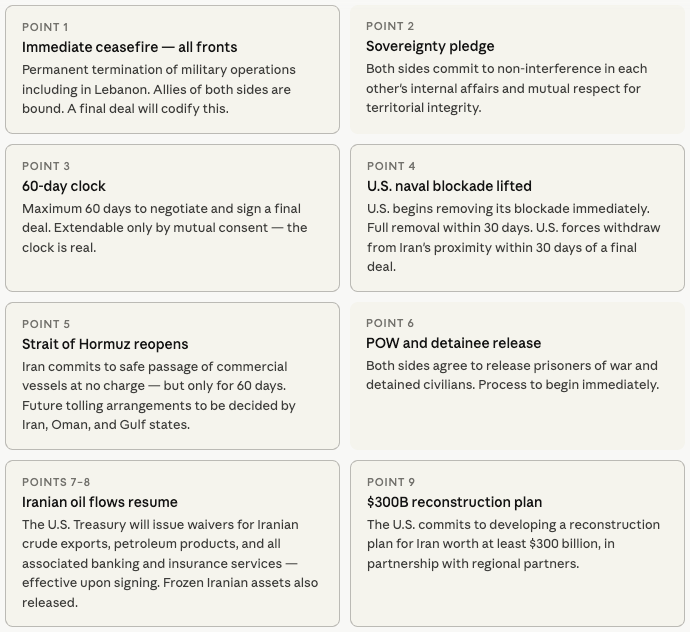
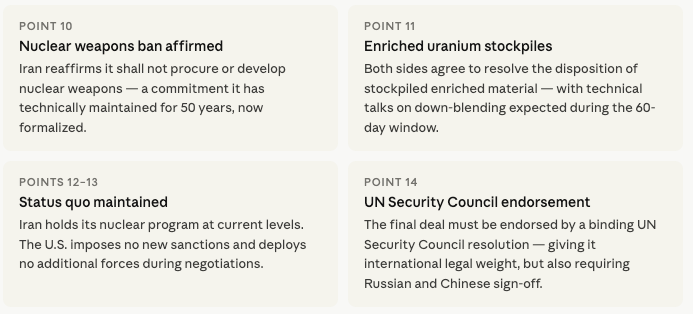
The 14 points, broken down
The line that defines the deal’s shelf life
“If it doesn’t get done in 60 days, that’s all right. We go back to bombing. I don’t want to do that, because it’s so good, but we might have to.”
— President Trump, G7 press conference, Evian, June 17, 2026
That quote is the single most important variable for market pricing right now. The 60-day window is both a countdown and a gun. Every week of productive nuclear talks should be modestly bullish for risk assets; any sign of breakdown is a swift, sharp risk-off trigger.
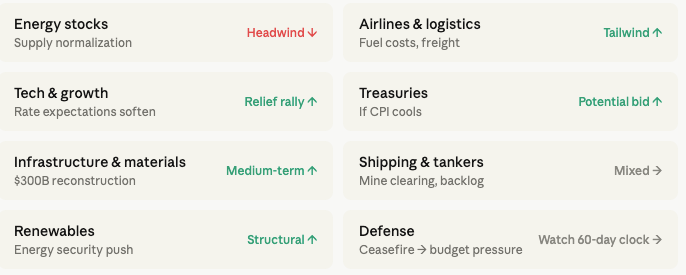
What the MOU means for markets — point by point
The most immediate market mover is Point 5 combined with Points 7 and 8. The Strait reopening plus the Treasury waivers on Iranian oil exports means meaningful supply is returning to the market essentially overnight. Brent has already fallen back to $79, erasing the entire conflict premium. With the IEA having called this the largest oil supply disruption in history, the reversal is equally historic in speed.
Point 9 — the $300 billion reconstruction commitment — is less discussed but potentially significant for construction, infrastructure, and industrial materials sectors. If talks succeed and a final deal unlocks that spending, it’s a meaningful demand signal for commodities like steel, cement, and copper, as well as for defense and engineering contractors with Middle East exposure.
The toll-free Strait access is notable for one key reason: it’s explicitly limited to 60 days. After that, future administration of the waterway falls to Iran, Oman, and Gulf states. U.S. officials claim Gulf states will never agree to tolls, but markets should price in some ongoing uncertainty premium around Hormuz access until a final deal settles this permanently.
Point 14‘s UN Security Council requirement is the sleeper risk. Russia and China hold vetoes. If the final deal drifts in a direction either finds unfavorable, the endorsement pathway becomes complicated — and a deal without it may have less legal durability than markets assume.
The Fed angle — does this flip the dot plot?
Yesterday’s dot plot showed nine FOMC members favoring rate hikes, with the median projection jumping to 3.8% — driven explicitly by energy-driven inflation from the conflict. If oil holds near $79 and Iranian supply normalizes over the coming weeks, the inflation data will begin to reflect that, likely starting with July’s CPI release.
That doesn’t mean hikes are off the table — the Fed is watching core inflation too, and second-round energy effects can be sticky. But the directional pressure on the dot plot changes materially. A deal that holds could shift the median projection back toward hold, or even eventually toward cuts, well before the end of 2026.
Sectors and assets to watch
Bottom line
The MOU is more substantive than many expected. Oil sanctions relief is immediate, the Strait reopens now, and Iran gets a credible path to sanctions removal and reconstruction funding. In exchange, the nuclear weapons commitment is reaffirmed and technical talks on enriched stockpiles begin.
The core risk hasn’t changed: this is an interim agreement with a hard expiration. The 60-day clock is ticking. A final deal requires resolving Iran’s nuclear program, U.S. sanctions, regional security arrangements, and UN endorsement — none of which are simple. But for now, the market has a genuine reason to reprice the conflict premium out. Whether that holds depends entirely on the Swiss negotiating table over the next two months.
Watch the July CPI print. Watch the nuclear talks timeline. And keep one eye on the 60-day expiry date: August 18.
Market analysis provided by The Macro Compass is for informational purposes only. Please consult with a financial advisor before making investment decisions.
 Evergreen Financial News